


Highlights
Stationery Cabinets for Organized Workplaces

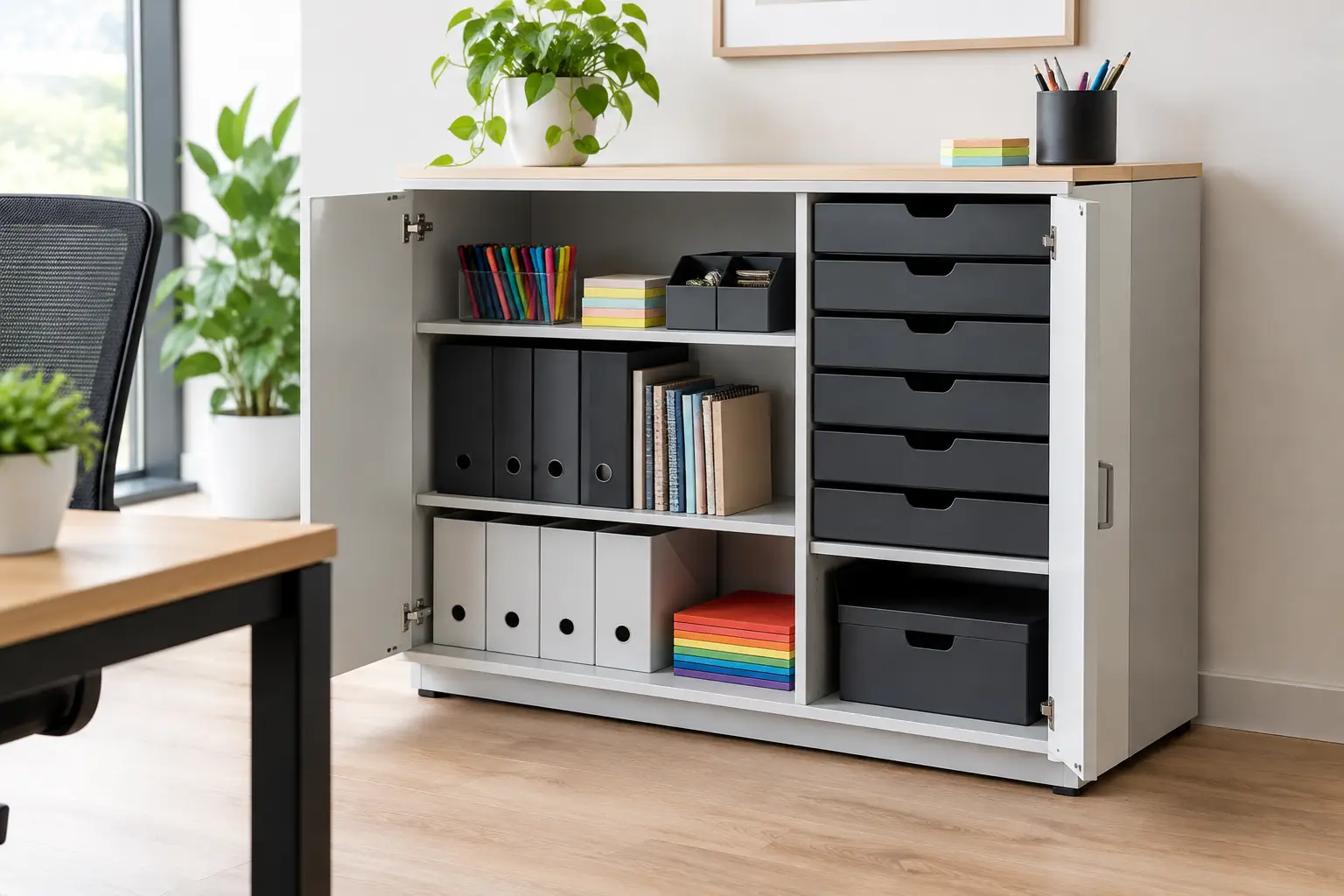
A missing box of printer toner can stop a busy office faster than a complex purchasing delay. The same applies to labels, envelopes, markers, forms, and everyday consumables that teams expect to find immediately. Well-planned stationery cabinets keep these items protected, visible, and controlled without taking over valuable workspace.
For facility managers and procurement teams, the goal is not simply to add a cabinet. It is to create a storage point that supports replenishment, reduces waste, and continues to perform as staff numbers, supply volumes, or site layouts change.
What Stationery Cabinets Need to Solve
Office supplies are often stored wherever space is available: a break room cupboard, an open shelf in the print area, or a drawer at reception. This arrangement works only while stock levels are low and a small number of people use the supplies. As usage increases, it creates duplicate orders, cluttered counters, damaged packaging, and uncertainty about what is actually on hand.
Stationery cabinets provide a defined home for consumables. A lockable metal cabinet can keep higher-value items such as toner cartridges, branded materials, batteries, and specialist labels under controlled access. Adjustable shelves allow the layout to change as the inventory changes, which is more practical than assigning every item to a fixed compartment.
The right solution depends on the operation. A small professional office may need one compact cabinet near a printer station. A school, healthcare facility, corporate campus, or shared workspace may need several cabinets across departments, each with defined stock responsibilities. In larger facilities, cabinets can form part of a wider storage plan alongside office cabinets, lockers, shelving, and secure charging units.
How to Specify Stationery Cabinets
A clear specification prevents a common procurement mistake: selecting a cabinet based only on external dimensions. Capacity matters, but daily access, shelf loading, security, and room conditions matter just as much.
Start With the Actual Inventory
List the items that will be stored, then separate fast-moving supplies from reserve stock. Printer paper and standard envelopes may need frequent access. Toner, labeled forms, spare devices, and department-specific materials may require restricted access. This distinction helps determine whether one shared cabinet is sufficient or whether separate locked sections are more appropriate.
Consider packaging sizes rather than just item counts. Paper cartons, archive boxes, and bulk cleaning materials occupy deeper shelf space than pens and staplers. Shelves should accommodate the largest routine item without forcing staff to stack stock unsafely or leave cartons on the floor.
It is also worth planning for seasonal demand. Schools may hold more paper and craft supplies before term starts, while offices can experience higher printing volumes around reporting periods. A cabinet that is permanently filled to capacity leaves no room for these predictable peaks.
Choose a Layout That Matches Access Patterns
Tall cabinets make efficient use of vertical space and suit stores or back-office areas where reserve stock is held. Lower cabinets are useful beneath counters or beside multifunction printers, where staff need frequent access without moving across the building. A combination of both can work well: a lower cabinet for everyday supplies and a taller unit for bulk replenishment.
Shelves should be adjustable so the cabinet remains useful when purchasing formats change. A fixed internal layout may appear orderly at first but can become inefficient when a team changes printers, moves to different paper sizes, or consolidates supplies from another department.
Doors also affect usability. Hinged doors provide full access to shelves and are straightforward for general stationery storage, provided there is enough clearance in front of the cabinet. Where aisle space is tight, cabinet placement needs careful review before ordering. A cabinet should improve circulation, not create a blockage at a busy print point or service desk.
Specify Metal Construction for Working Environments
Office supplies are light individually, but the combined weight of paper, files, toner, and boxed materials can be substantial. Metal stationery cabinets are suited to repeated use and heavier loads, particularly in shared workplaces where doors and shelves are opened throughout the day.
Look beyond appearance and assess the working details: cabinet body strength, shelf support, door alignment, lock quality, and surface finish. Powder-coated metal is practical for routine commercial use because it provides a durable finish that is easy to maintain. In utility rooms, education sites, workshops, and high-traffic offices, this durability is more valuable than a cabinet designed primarily for occasional domestic use.
Build Access Control Into the Storage Plan
Not every supply needs to be locked away. Open access to low-cost, frequently used items can save time. However, controlled access is sensible for stock that is expensive, sensitive, or easily misplaced. A lockable cabinet also helps managers maintain a more accurate view of consumption.
The level of control should reflect the workplace. A single key lock may be adequate for a small office managed by one administrator. Larger sites may assign cabinet access to department leads, facilities staff, or stock coordinators. The important point is consistency: staff should know where supplies are held and who is responsible for replenishment.
Avoid turning the cabinet into a barrier. If employees must repeatedly search for the key or wait for one person to open the doors, they may create unofficial supply stashes at their desks. A practical access policy protects stock while allowing normal work to continue.
Plan the Space Around the Cabinet
The cabinet footprint is only one part of the space requirement. Measure the wall area, floor depth, and door swing clearance. Check whether the cabinet will be placed near a printer, loading route, or emergency access point. In compact offices, a tall cabinet may offer better capacity than multiple low units, but only if upper shelves can be reached safely.
Position cabinets close enough to the point of use to make replenishment easy. A print room is an obvious location for paper and toner, while reception may need a smaller secure cabinet for visitor materials, forms, and mailing supplies. Centralizing every item can simplify stock control, but it may increase unnecessary staff movement in a large facility. The best arrangement balances control with convenience.
For multi-site projects, standardizing cabinet sizes and internal shelf arrangements can make stock procedures easier to repeat. Teams can recognize the same storage logic from one office or department to another, and replacement or expansion orders become more straightforward.
What to Include in a Procurement Specification
A concise specification gives suppliers the information needed to recommend suitable stationery cabinets and quote accurately. It should cover more than dimensions. Include these operational requirements:
- Required cabinet height, width, depth, and available installation space
- Number of shelves, expected load, and need for shelf adjustability
- Door type, lock requirement, and who needs access
- Finish color and whether the cabinet must match existing metal furniture
- Quantity, delivery schedule, and any project-specific customization needs
For larger orders, ask whether the manufacturer can provide consistent finishes and configurations across the full project. This matters when cabinets are being installed in several departments or delivered in phases. It is also useful to confirm minimum order flexibility if the project includes both standard items and a smaller number of custom units.
Choose a Supplier That Can Support Change
Stationery storage is rarely static. Departments move, headcount changes, and paper-based processes may expand or contract. A supplier with a broad metal storage range can help maintain consistency when a project later requires additional office cabinets, lockers, shelving, or specialized storage.
Manufacturing capability also matters when standard dimensions do not fit the room or the inventory. Custom fabrication can address unusual widths, shelf arrangements, finishes, or locking requirements, but it should be used where it solves a real operational problem. Standard cabinets are often the faster and more cost-effective option when they meet the specification.
Loxmet supports commercial buyers with heavy-duty metal storage solutions, standard product availability, and custom production for workplace requirements. For procurement teams, that combination can reduce the need to manage separate suppliers for closely related storage needs.
A well-positioned cabinet will not make supplies last longer, but it will make consumption easier to see, replenishment easier to manage, and the workday less dependent on last-minute searches. Start with the items your teams reach for most, then specify storage that will still work when the next shipment arrives.