


Highlights
Sliding Door Filing Cabinet for Busy Offices

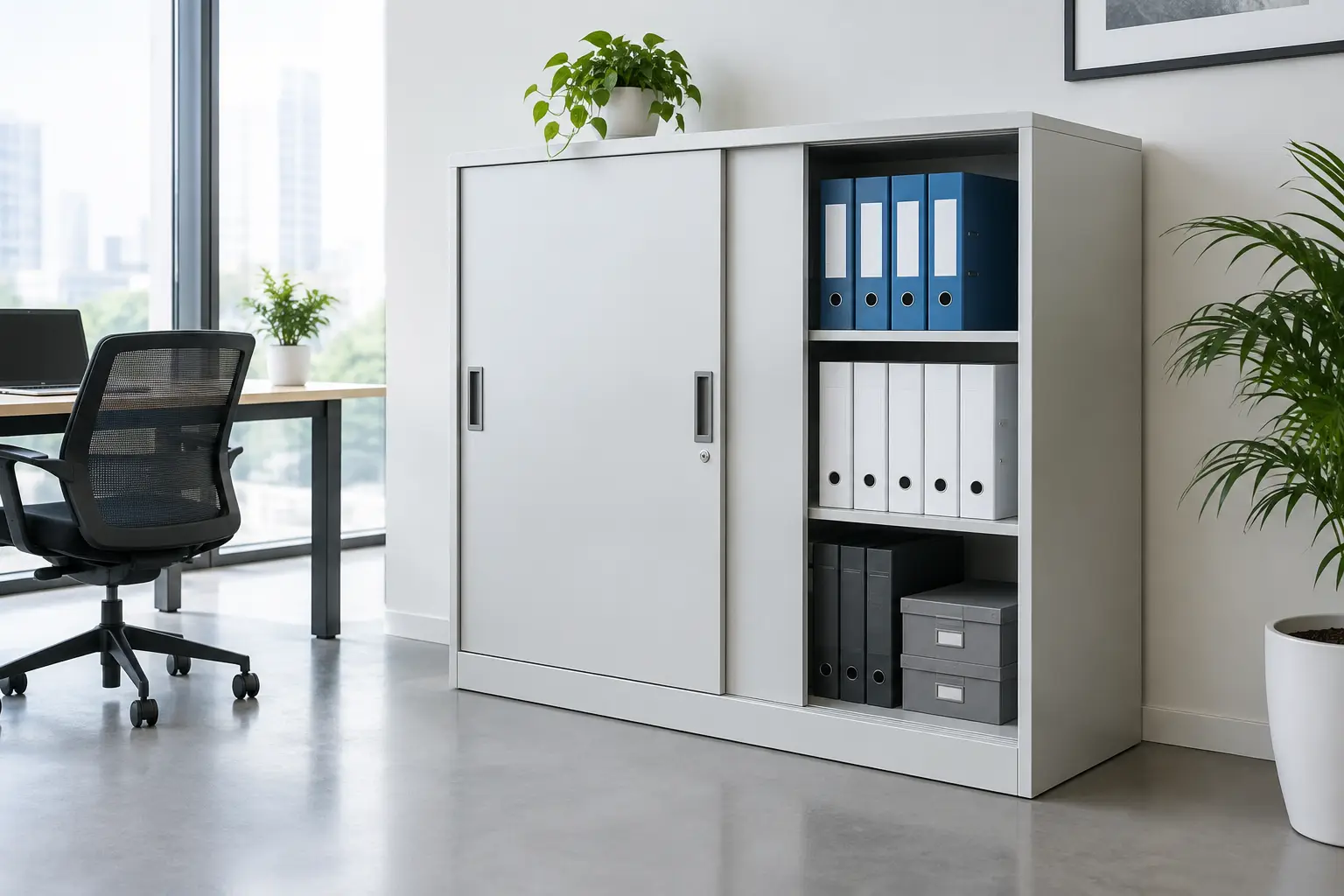
A sliding door filing cabinet solves a practical problem that standard swing-door storage often creates: open doors occupy the same aisle space employees need to move, retrieve files, and work safely. For offices, schools, clinics, and industrial facilities with dense layouts, the right metal cabinet keeps records protected without turning document access into a traffic issue.
This is not simply a question of choosing a cabinet that fits against a wall. Buyers need to consider file volume, document format, access frequency, security level, floor conditions, and expected service life. A well-specified cabinet becomes dependable infrastructure. A poorly specified one becomes an obstacle, a weak point in records security, or an early replacement cost.
Why Choose a Sliding Door Filing Cabinet?
The main advantage is its operating footprint. Sliding doors travel within the cabinet width, so they do not project into corridors or workstation clearances. That makes this cabinet style particularly useful in compact offices, archive rooms, administrative areas, reception back offices, and shared workspaces.
It also supports controlled access in high-traffic areas. A user can open one side, retrieve a folder, and close the cabinet without blocking a walkway. Where cabinets are installed in rows or along narrow walls, that difference improves daily workflow.
Metal construction adds another operational benefit: it is built for repeated use. A quality steel cabinet resists the dents, loose hinges, swollen panels, and alignment problems that can affect lighter storage units over time. For procurement teams planning multi-year facility investments, durability is usually more valuable than a low initial purchase price.
Sliding doors do involve a trade-off. Only part of the cabinet interior is accessible at one time, unlike a fully opened swing-door cabinet. This is rarely a concern for organized filing systems, but it should be considered where several staff members need access to the full cabinet simultaneously.
Start With the Records, Not the Cabinet Size
A cabinet should be specified around the filing system it will hold. Measure current records, allow for planned growth, and identify the document formats used by each department. Letter-size folders, legal-size files, binders, archive boxes, and mixed paper records require different internal arrangements.
For active records, adjustable shelves can provide practical flexibility. They allow facility teams to change the interior as filing practices evolve, rather than replacing the cabinet when binder heights or archive box dimensions change. For heavier paper loads, shelf capacity matters as much as the overall cabinet dimensions. Paper is dense, and a fully loaded shelf can carry significantly more weight than expected.
Archive storage should be planned with a realistic retention schedule. A cabinet filled to capacity on delivery leaves no room for incoming records and encourages files to be stacked on top, stored in aisles, or placed in unsuitable locations. A sensible allowance for growth protects both accessibility and housekeeping standards.
When several departments share a storage area, consider whether one large cabinet is actually the best option. Multiple cabinets with assigned sections may improve ownership and access control. It can also make future office reconfiguration easier.
Check Internal Dimensions Carefully
External width and height are useful for layout planning, but internal dimensions determine what the cabinet can store. Door tracks, side panels, shelf supports, and rear reinforcements all reduce usable space.
Ask for clear internal width, depth, and shelf spacing. Confirm whether shelves are adjustable, whether they are supported along the full depth, and whether the cabinet can accept filing frames or dividers where required. If legal-size folders or deep archive boxes are part of the brief, a shallow cabinet may create an expensive problem after installation.
Specify Construction for Daily Use
A filing cabinet used once a week has different requirements from one accessed throughout every workday. In busy environments, the door system and cabinet structure deserve close attention.
The steel body should be rigid enough to remain square under load. A cabinet that twists or flexes can cause sliding doors to bind, create uneven gaps, and reduce the effectiveness of the lock. Reinforced corners, formed steel panels, and properly supported shelves contribute to long-term alignment.
Door movement should feel controlled rather than loose. Quality guide tracks and rollers reduce noise and help doors travel consistently over thousands of opening cycles. In dusty industrial settings or facilities with frequent cleaning, track design is especially relevant because accumulated debris can affect movement.
The finish should also match the environment. Powder-coated steel provides a durable surface that is easy to maintain and appropriate for most offices and institutional spaces. In humid, demanding, or specialized environments, buyers should discuss the required corrosion protection and coating specification before production begins.
A practical specification review should cover these four points:
- Steel thickness and structural reinforcement for the expected load and usage level
- Shelf load capacity, including the weight of binders, paper files, and archive boxes
- Sliding door track and roller design, with attention to repeated daily operation
- Coating finish and color requirements for the facility environment
These details are more useful than broad claims about cabinet quality. They allow purchasing teams to compare products on performance, not appearance alone.
Security Depends on Access Requirements
Most filing cabinets hold information that should not be openly available to every visitor or employee. Personnel records, financial documents, student files, medical administration paperwork, contracts, and operational records all require an appropriate level of control.
For general office use, a central locking system may be sufficient. It allows authorized staff to secure both sliding doors with one key. In larger facilities, key management should be planned from the start. Duplicate keys, master-key options, numbered locks, and replacement-key procedures can prevent a simple cabinet lock from becoming an administrative burden.
Where access must be restricted more closely, consider cabinets assigned to a specific department or user group. A single large cabinet with one lock may be efficient for storage volume but may not meet internal confidentiality procedures.
Do not assume that a standard metal filing cabinet provides fire protection. Fire-rated document storage requires tested and certified construction for the stated protection level. If records are business-critical or subject to formal retention requirements, confirm the necessary certification rather than relying on the presence of a metal body.
Plan the Installation Area
A sliding-door design saves clearance in front of the cabinet, but installation still needs careful planning. Measure wall length, ceiling obstructions, electrical panels, sprinkler access, emergency routes, and the path used to deliver the cabinet into the building.
Floor level is particularly important. A cabinet placed on an uneven surface may sit out of square, which can affect door travel and lock alignment. Adjustable feet or suitable leveling methods may be needed, especially in older buildings, workshops, and converted spaces.
For tall or heavily loaded cabinets, anchoring should be assessed as part of the installation plan. Secure fixing improves stability and supports safe use, particularly where cabinets are opened frequently or located in shared facilities. Follow the product guidance and site safety requirements rather than treating anchoring as an optional final step.
The cabinet location should support the filing process. Frequently used records belong close to the teams that need them, while long-term archives can be positioned in lower-traffic storage areas. This simple distinction reduces unnecessary movement and keeps active work zones clear.
When Custom Cabinet Production Adds Value
Standard cabinet sizes work well for many projects, especially when lead time and consistent product availability are priorities. Custom production becomes valuable when the room, filing system, or access requirements fall outside standard dimensions.
A custom sliding door filing cabinet can be designed around a restricted wall length, unusual ceiling height, specific shelf spacing, corporate colors, lock requirements, or a mixed storage layout. For example, one section may be arranged for folders while another is configured for binders, boxed records, or secured equipment.
Custom work should begin with clear operational information, not only a preferred exterior size. Provide the available installation space, stored item dimensions, estimated loads, access needs, finish requirements, and quantity. This gives the manufacturer a proper basis for selecting materials, reinforcements, internal fittings, and door configuration.
For project buyers and distributors, working with a manufacturer such as Loxmet can also simplify broader storage procurement. Filing cabinets, office cabinets, lockers, shelving, and specialized metal storage can be aligned in finish, build quality, and delivery planning across the same facility.
A Better Purchase Decision Starts With Daily Use
The best cabinet is not necessarily the largest unit or the one with the lowest quoted price. It is the one that fits the records, the room, and the people who will operate it every day. A clear specification for capacity, construction, security, and installation turns filing storage into a reliable part of the workplace instead of a recurring facilities issue.
Before approving the order, picture the cabinet at its busiest: doors opening repeatedly, shelves fully loaded, staff moving through the aisle, and records needing to be found without delay. If the product supports that moment, it is likely the right choice for the years ahead.