


Highlights
4 Drawer Lateral File Cabinet Buying Guide

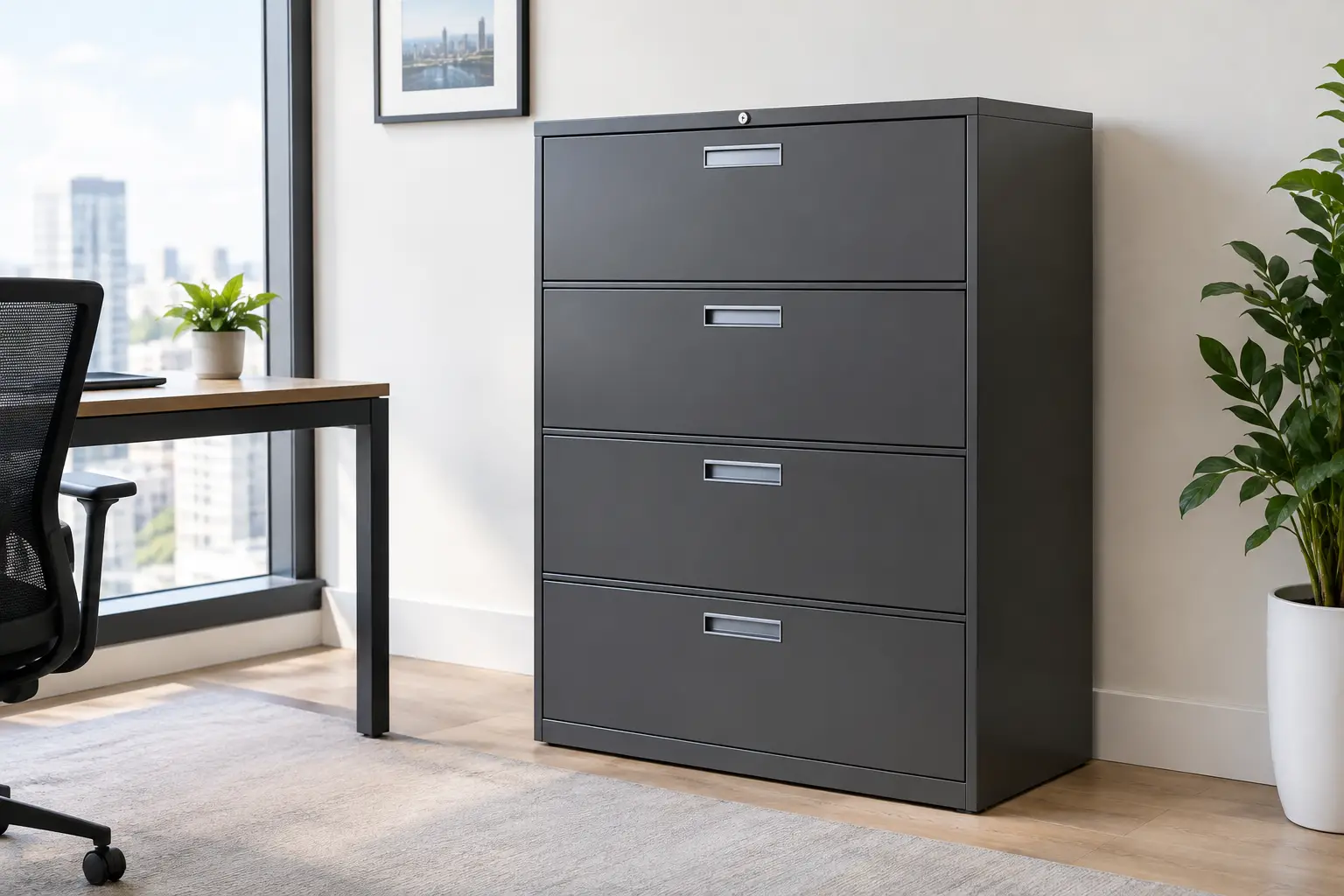
Paper records still create a real storage problem in offices, schools, healthcare facilities, and administrative departments. A 4 drawer lateral file cabinet gives high document capacity without taking over the room, provided it is specified for the files, floor plan, and security level of the facility.
For commercial buyers, this is not simply a question of choosing a cabinet that looks suitable. Drawer width, load capacity, anti-tip protection, lock configuration, steel construction, and delivery access all affect whether the cabinet will perform reliably over years of daily use.
Why Choose a 4 Drawer Lateral File Cabinet?
A lateral cabinet stores files side to side across a wide drawer rather than front to back. This layout gives users a clearer view of file labels and makes better use of wall space in rooms where depth is limited. A four-drawer configuration adds vertical capacity for active records, archived files, personnel documents, contracts, and departmental paperwork.
It is often the right choice when a facility needs substantial filing capacity but cannot dedicate an entire room to records storage. Positioned along a wall, a lateral cabinet keeps aisles clearer than deep filing units. It can also support a practical work surface for printers, trays, or frequently used office equipment, if the product load rating permits it.
The trade-off is width. A lateral unit generally needs more wall length than a narrow vertical cabinet, and every fully extended drawer requires clear space in front. Facility planners should account for both the cabinet footprint and the operating space required for staff to access files safely.
Start With File Format and Capacity
The first specification should be the file format. Letter-size and legal-size folders need different drawer arrangements, rails, and internal clearances. A cabinet that accepts one format only may be efficient for a standardized records system. A facility managing mixed files may need adjustable filing rails or dividers that support both orientations.
Do not estimate capacity based on drawer count alone. Internal drawer width, usable depth, rail placement, and the thickness of folders determine how much each drawer can actually hold. Large departments should also consider future growth. Filling every drawer at installation leaves little flexibility when new employees, clients, or regulatory records are added.
For procurement teams, it is useful to define the required filing capacity in linear inches or linear feet before reviewing products. This makes it easier to compare cabinet configurations fairly and prevents underbuying. A four-drawer cabinet can be an efficient centralized filing point for a small department, while larger operations may need coordinated banks of cabinets with consistent dimensions and keying.
Construction Matters in High-Use Environments
A commercial filing cabinet should be selected as working equipment, not light-duty office furniture. Steel gauge, formed drawer bodies, reinforced fronts, and stable cabinet construction all influence how well it handles repeated opening, heavy paper loads, and occasional impacts from carts or cleaning equipment.
Drawer slides deserve close attention. Full-extension slides allow staff to reach files at the rear without removing folders from the front. They are particularly useful when drawers are full or when records must be retrieved quickly. Smooth slide action also reduces the tendency for users to pull, force, or misalign drawers over time.
Load rating is equally important. Paper is heavier than it appears. A drawer filled with legal files, binders, or archived documents can place significant stress on the slides and cabinet frame. Confirm the stated load capacity per drawer and assess it against actual filing practices, not just the expected average load. If users tend to store binders, manuals, or boxed materials in file drawers, a higher-duty configuration is the safer specification.
A powder-coated finish helps protect steel from scratches and everyday wear. For offices, public institutions, and customer-facing spaces, finish consistency also matters when multiple cabinets are installed over several phases. A manufacturer able to maintain standard colors and produce project-specific finishes can simplify long-term facility planning.
Safety Features Are Part of the Specification
A loaded four-drawer lateral cabinet has a high center of gravity when upper drawers are extended. Anti-tip protection is therefore a core requirement, not an optional extra. An interlock mechanism limits the number of drawers that can open at one time, helping prevent instability. Wall anchoring may also be appropriate, especially in high-traffic areas, public facilities, or locations with uneven flooring.
Cabinets should be installed on a level surface and loaded with the heaviest materials in lower drawers whenever possible. This straightforward practice improves stability and helps drawers operate correctly.
Locking requirements depend on the records stored inside. General office filing may only require a central lock that secures all drawers. Personnel files, financial records, patient documentation, or confidential project materials may call for restricted key control, separate locking zones, or an integrated lock system aligned with the facility’s access policy.
Security is more than a lock cylinder. Review how the drawer fronts close, whether the cabinet can be anchored, and who will control replacement keys. For distributed sites, standardized keying can reduce administrative confusion. For sensitive departments, controlled access and documented key management may be more valuable than convenience.
Plan Dimensions, Delivery, and Installation
Before placing an order, verify the overall width, depth, height, and drawer extension. Measure the intended wall area, nearby doors, circulation routes, baseboards, power outlets, and the clearance needed for a person to stand in front of an open drawer. In compact offices, an apparently suitable cabinet can obstruct a walkway once it is in use.
Delivery access should be checked with the same care. Confirm doorway widths, elevator capacity, corridors, turns, stair access, and floor loading where relevant. Large steel cabinets are durable, but their weight requires a practical delivery route and proper handling equipment.
For projects with multiple rooms or floors, establish an installation plan before shipment. Decide where each cabinet will be placed, who will anchor it if required, and whether floor protection is needed during positioning. This avoids delays at handover and reduces the risk of placing heavy units in the wrong location.
Specify the Cabinet for the Work Environment
A 4 drawer lateral file cabinet used in a quiet administrative office may prioritize appearance, compact dimensions, and everyday file access. The same cabinet used in a warehouse office, school administration area, clinic, or public-sector facility may need a tougher finish, heavier drawer rating, more controlled locking, and anchoring provisions.
The most effective purchasing approach is to create a short performance brief before requesting quotes. It should state file format, estimated drawer load, required lock type, target dimensions, finish, quantity, delivery schedule, and any site-specific installation constraints. This gives suppliers the information needed to recommend a standard model or identify where custom fabrication will add value.
Customization can be practical when a project needs nonstandard dimensions, specific color matching, different internal rail arrangements, or coordinated storage across offices, changing rooms, and industrial work areas. It should not be used without purpose. Standard products often offer faster delivery and simpler replacement planning, while custom units are best reserved for a clear operational requirement.
A Better Long-Term Filing Decision
Price matters, but the lowest initial cost can become expensive if drawers sag, locks fail, or the cabinet cannot accommodate the organization’s file system. Evaluate total service life: construction quality, warranty coverage, availability of parts, finish durability, and the supplier’s ability to support repeat orders all contribute to the real value of the purchase.
Loxmet manufactures heavy-duty metal storage solutions for commercial projects where consistency, durability, and flexible specifications matter. For buyers managing larger rollouts, matching filing cabinets with other metal office storage can also create a more organized and maintainable workplace standard.
Choose the cabinet around the way people retrieve, secure, and grow their records. When the dimensions, load capacity, and safety features match the operation, filing becomes a dependable part of the workspace rather than a recurring facilities problem.