


Highlights
Lockable Cell Phone Charging Station Guide

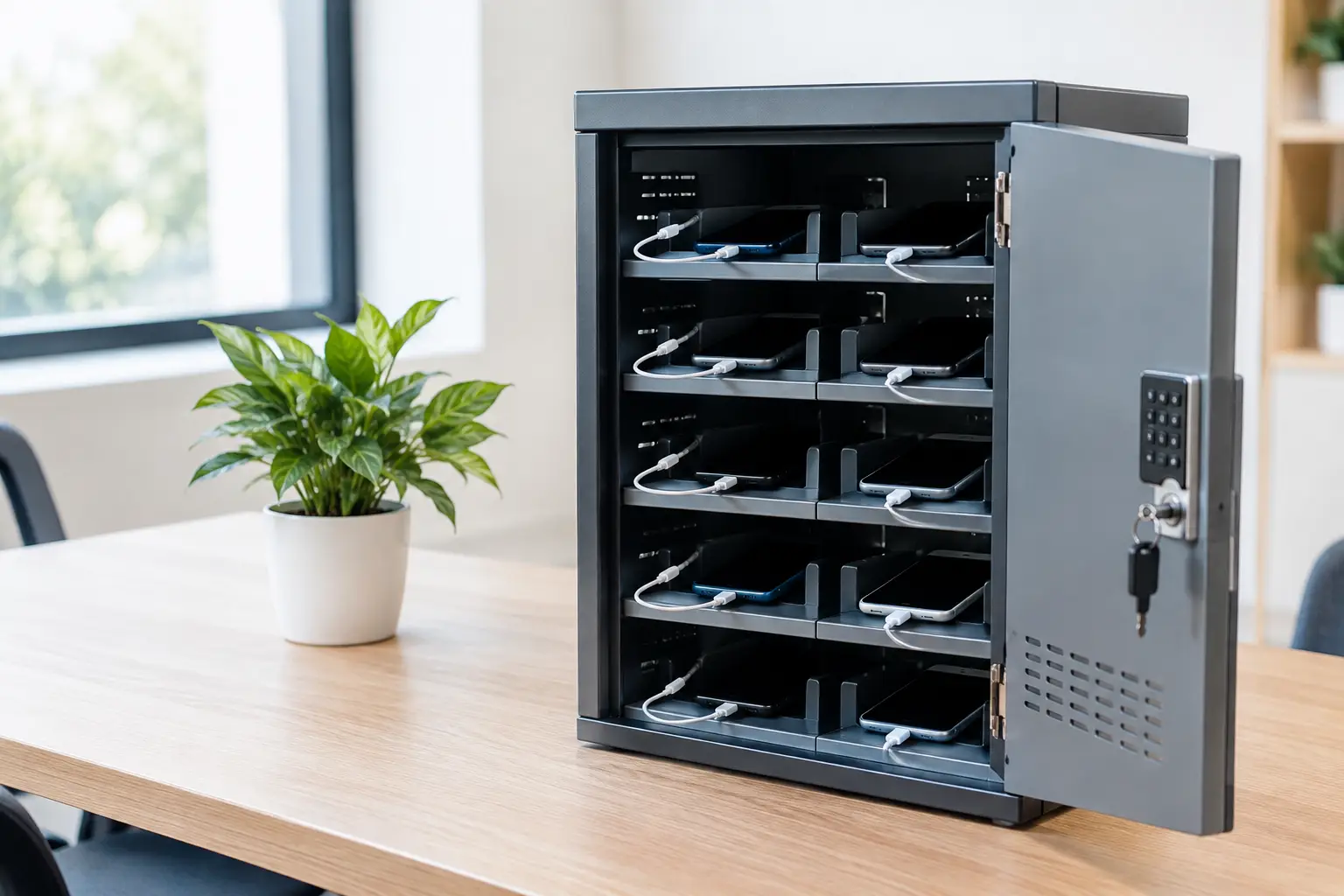
A dead phone during a shift, class, appointment, or visitor check-in is more than a small inconvenience. It interrupts communication, delays work, and encourages people to leave valuable devices on desks, counters, and wall outlets. A lockable cell phone charging station gives facilities a controlled place to store and charge phones while keeping them separated, secure, and ready for collection.
For commercial buyers, the decision is not simply about adding charging ports. It is about selecting a unit that can handle repeated daily use, fit the available space, support the right number of users, and remain manageable for staff. The strongest solution combines secure metal construction, practical compartment sizing, safe power management, and a lock system that matches how the facility operates.
What a Lockable Cell Phone Charging Station Solves
Shared charging creates predictable problems in busy environments. Devices can be misplaced, charging cables disappear, outlets become overcrowded, and staff may have no clear responsibility for unattended phones. These issues are especially common in schools, offices, warehouses, gyms, healthcare facilities, training centers, public venues, and employee break areas.
A charging station organizes this process by assigning each device a separate compartment. The user places the phone inside, connects it to power, closes the door, and retrieves it later. This protects personal devices from casual access and keeps charging activity away from work surfaces, walkways, and reception counters.
The value increases when phones must be stored during working hours or restricted periods. Manufacturing sites may require employees to keep personal phones outside production areas. Schools may need a controlled phone-storage point during lessons. Event venues and service centers may offer secure charging as a practical visitor amenity. In each case, charging and security work together rather than being treated as separate needs.
Choosing the Right Lockable Cell Phone Charging Station
The correct configuration depends on the number of users, charging habits, installation location, and level of supervision. A compact unit may suit a small office team, while a high-capacity cabinet is more appropriate for a school corridor, employee changing area, or shared workplace hub.
Start with capacity and turnover
Count the devices that may need charging at the same time, not just the total number of people in the building. A 20-person office may only require 10 compartments if employees charge devices at different times. A classroom, training room, or shift-change area may need enough doors for every user at once.
Also consider turnover. Short-stay users tend to need accessible compartments and clear identification. Employees using the station every day may benefit from assigned compartments or repeatable locking arrangements. High turnover can justify a larger number of smaller doors, while assigned use may call for compartments sized for a phone, cable, and compact power adapter.
Match compartment size to the devices being stored
Most phones fit into compact locker compartments, but the station should allow for charging cables, protective cases, and larger models. If users may store tablets, handheld scanners, radios, or power banks, standard phone-only dimensions may be too restrictive.
This is where custom fabrication can be useful. A manufacturer can adjust compartment dimensions, door counts, ventilation arrangements, cable access, and overall cabinet size for the equipment used on site. Buyers should define the actual device mix before approving a layout. A station that only fits one phone model can become a limitation quickly.
Select locks based on user behavior
The lock choice should reflect whether storage is temporary, assigned, or managed by staff. Key locks are straightforward and economical, but key control must be planned. Combination locks reduce the need for keys and can work well for assigned users. Digital or RFID locking systems can support higher-control environments, though they add cost and may require administrative setup.
For temporary use, a public or shared-use lock arrangement can be practical. For long-term employee storage, individual keys or assigned codes are often easier to manage. There is no single best lock for every facility. The best option is the one that avoids daily friction while providing the required level of accountability.
Construction Matters in High-Use Areas
A charging cabinet is frequently opened, closed, moved, cleaned, and used by people who may not treat it gently. Thin material, weak hinges, poorly aligned doors, and light-duty locks will show their limits quickly in shared environments.
Commercial buyers should look for metal construction suited to repeated use, reinforced doors, reliable hinges, and a durable powder-coated finish. The cabinet should remain stable when multiple doors are open and should be designed for the installation method planned for the site. Wall-mounted stations save floor space, while freestanding models can serve larger groups or be positioned where charging demand is highest.
Door ventilation also deserves attention. Phones produce heat while charging, particularly when several devices are connected at once. Ventilation should allow air movement without compromising security or making it easy to reach devices through the cabinet. The right balance depends on the charging system, number of compartments, and expected duty cycle.
Plan the Charging System, Not Just the Cabinet
The metal enclosure and the electrical setup must work as one system. Before purchase, confirm how devices will be powered. Some stations use internal power strips and individual outlets. Others provide USB charging ports, USB-C connections, or a combination of charging options. USB-C is increasingly relevant for newer phones and tablets, but mixed-device facilities may still need conventional outlets or flexible cable arrangements.
Cable management is a practical detail with a major effect on daily use. Loose cables become tangled, damaged, or removed from the cabinet. A well-planned charging station provides a protected route for cables and enough space to connect devices without forcing doors shut against cords.
Electrical safety requirements vary by market and installation. Buyers should confirm that the charging components, plugs, voltage, grounding, and cable routing are appropriate for the destination and local facility requirements. If the station is being specified for a project, electrical details should be agreed before production rather than treated as an on-site adjustment.
Where Placement Determines Success
The best charging station can be underused if it is placed in the wrong location. Users need to reach it without creating congestion, yet the unit should not sit in an exposed area where devices are visible to passersby or doors are likely to be hit by carts and equipment.
For employees, break rooms, locker areas, and controlled entrances are often practical locations. Schools may place units in supervised corridors, staff rooms, or designated device-storage zones. Reception areas can work for visitor use, provided staff have a clear process for access and responsibility.
Consider the wall structure, available power supply, cleaning access, and traffic flow. A wall-mounted unit requires suitable fixing points and should be installed at a usable height for the intended users. A freestanding cabinet needs stable positioning and adequate clearance for doors to open fully. If accessibility is a requirement, compartment heights and operating controls should be considered during layout planning.
Questions to Resolve Before Ordering
A clear specification reduces delays and prevents a station from arriving with the wrong capacity or charging arrangement. Procurement teams should confirm the following points before requesting final pricing or production approval:
- How many devices need charging at peak demand?
- What types of devices, cases, and chargers must fit inside each compartment?
- Will use be temporary, assigned, or managed by staff?
- Which lock system fits the facility’s control process?
- Does the unit need wall mounting, freestanding installation, or both options?
- What charging connections, plug type, and electrical requirements apply at the site?
These questions also help distributors and fit-out professionals compare products accurately. Price alone does not show the difference between a light-use cabinet and a station designed for repeated commercial use.
Custom Stations for Specific Operations
Standard charging lockers are efficient when requirements are straightforward and delivery speed is the priority. Custom production becomes valuable when a project has unusual dimensions, a defined color scheme, integrated numbering, special locks, mixed device sizes, or a need to combine charging with personal storage.
For example, an industrial employer may require a cabinet with small charging compartments near a changing area, using numbered doors and master-key access for supervisors. A training provider may need larger compartments that hold phones, tablets, and accessories. A corporate fit-out may require a cabinet finish that matches existing metal storage products. These are operational requirements, not cosmetic extras.
As a metal furniture manufacturer, Loxmet can support both standard charging locker requirements and project-specific configurations. The objective should remain simple: provide secure charging that fits the facility, the devices, and the people using it every day.
A well-specified charging station quietly removes a recurring problem from the workplace. When users know where to charge, how to secure their phones, and when to collect them, the facility stays more organized and staff can focus on the work in front of them.