


Highlights
Pedestal Cabinet Selection for Productive Offices

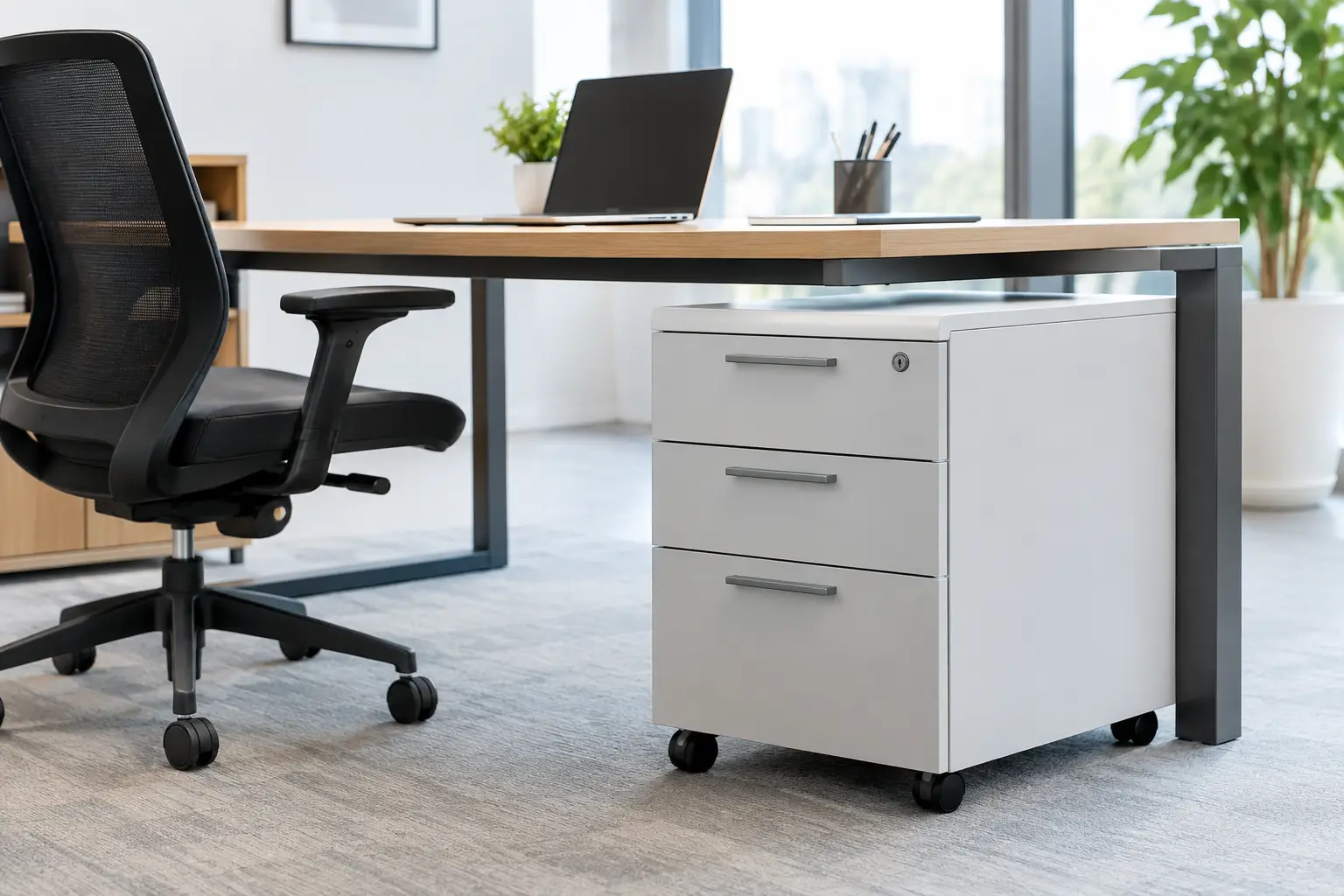
A pedestal cabinet is a small storage unit, but it has a direct effect on how efficiently people work. Positioned under or beside a desk, it keeps active files, personal items, stationery, and work tools within reach without consuming valuable floor area. For offices, control rooms, schools, healthcare facilities, and commercial fit-outs, the right unit must do more than fill an empty space. It must withstand daily use, fit the workstation correctly, and provide the right level of security.
For procurement teams, the decision is rarely about one cabinet. It is about specifying a repeatable storage solution across dozens or hundreds of workstations. Consistent dimensions, dependable locking, durable finishes, and reliable production lead times matter as much as appearance.
What a Pedestal Cabinet Should Deliver
A well-specified pedestal cabinet supports a cleaner, more organized workstation. Employees should be able to access routine materials quickly while keeping confidential documents and personal belongings protected. In shared offices, assigned storage also reduces clutter on desks and in common areas.
The basic format is simple: a compact cabinet with drawers, normally designed to fit under a desk or sit alongside one. However, its configuration determines how useful it will be. A shallow drawer is practical for pens, chargers, notebooks, and small office supplies. Deeper drawers accommodate folders, records, and larger personal items. Some applications require a dedicated filing drawer, while others benefit more from multiple equal-depth drawers.
The cabinet should also match the furniture layout. An under-desk model needs sufficient clearance for legroom, desk frames, cable trays, and task chairs. A freestanding pedestal needs a stable base and dimensions that align with the desk height. These details are easy to overlook during planning and expensive to correct once a project is installed.
Fixed or Mobile Pedestal Cabinet Designs
The first specification decision is whether the cabinet should remain fixed in place or move with the user.
Fixed pedestal cabinets are suitable where workstation layouts are permanent and security is a priority. They create a consistent look across open-plan offices and are useful in reception areas, administrative departments, call centers, and education facilities. A fixed unit also avoids the risk of cabinets being moved into circulation paths or used in unsuitable locations.
Mobile pedestal cabinets are more flexible. Casters allow staff to reposition storage when desks are reconfigured, teams move, or cleaning is required. They are often preferred in agile offices, project spaces, and commercial interiors where layouts change over time. Mobility should not compromise stability. Select heavy-duty casters and a cabinet body designed to remain balanced when drawers are fully loaded.
The right choice depends on how the facility operates. A fixed arrangement works best for controlled, standardized workstations. A mobile arrangement is more appropriate when furniture must adapt to changing teams and tasks.
Choose Metal Construction for Demanding Use
Material selection has a long-term impact on maintenance, security, and replacement costs. While lightweight office storage can be adequate in low-use settings, commercial buyers frequently need a more durable solution.
Metal pedestal cabinets are well suited to workplaces with constant daily traffic. A properly manufactured steel body resists impacts, drawer misalignment, and surface damage better than many lighter alternatives. It is also a practical choice for industrial offices, schools, public institutions, healthcare administration areas, and shared work environments where furniture is used by multiple shifts.
Look beyond the exterior panel. The quality of the cabinet depends on the full construction: steel thickness, reinforcement points, drawer runner capacity, weld quality, anti-tip design, handle strength, and powder-coated finish. A smooth finish is not only visual. It helps protect the cabinet against scratches, moisture, and routine cleaning.
Color can be selected to match desks, lockers, shelving, or wider interior standards. For larger projects, consistent powder-coat colors help create a coordinated workplace rather than a collection of unrelated furniture pieces.
Drawer Layout and Filing Requirements
Drawer configuration should follow the materials employees use every day. Buying the same three-drawer unit for every department may simplify ordering, but it can create inefficient storage if job roles differ.
Administrative teams may require a combination of stationery storage and filing capacity. Finance, human resources, and legal teams may need deeper drawers for protected records. Design, engineering, and technical teams may require storage for devices, samples, manuals, or specialist tools. A reception desk may benefit from compact drawers that keep small items secure without restricting movement in a confined area.
Before specifying a cabinet, confirm the file format used by the organization. Letter-size and legal-size hanging files require different internal dimensions. If the filing drawer will carry heavy paper loads, drawer runners and suspension components should be rated for that purpose. A drawer that operates smoothly when empty can become difficult to use after months of full loading.
For shared workstations, consider whether each user requires an individual cabinet or whether centralized storage is more efficient. Personal pedestal cabinets work well for assigned desks. Hot-desking environments may be better served by lockers or centralized secure storage, with pedestal cabinets reserved for shared supplies and operational documents.
Locking Options That Match the Risk
A lock is not a minor accessory. It defines whether the cabinet can be trusted with sensitive documents, personal belongings, company devices, or controlled supplies.
A central locking system is commonly used for office pedestal cabinets because one key can secure all drawers. This improves convenience for the user and reduces the chance of leaving one drawer open. For larger installations, key management should be planned in advance. Procurement teams should confirm whether master key systems, replacement keys, and numbered lock records are available.
Electronic locking may be appropriate for facilities that need access control without traditional keys. This can be useful in shared offices, healthcare administration, laboratories, and high-turnover work areas. The trade-off is greater system complexity. Electronic options should be selected only when the site can support battery replacement, user management, and maintenance procedures.
For filing cabinets, an anti-tip mechanism is a valuable safety feature. It prevents multiple loaded drawers from opening at the same time, reducing the risk of the unit tipping forward. This is especially relevant for taller or heavily loaded cabinets.
Dimensions, Clearance, and Installation Planning
Cabinet dimensions should be checked against the actual workstation, not only the furniture schedule. Desk height, support legs, modesty panels, electrical outlets, floor boxes, and cable management systems can all affect fit.
Measure the available width, depth, and height beneath the desk. Allow enough room for chair movement and for opening drawers fully. A deep cabinet may provide useful storage, but it can obstruct circulation if it extends beyond the desk footprint. In narrow office aisles, even a small projection can become a daily inconvenience.
Also consider delivery and installation access. For projects in upper floors, older buildings, or restricted service areas, cabinet dimensions and packaging need to be compatible with elevators, corridors, and door openings. Standardized products can speed delivery, while custom dimensions may be worthwhile when workstations have nonstandard sizes or unusual clearance limits.
How Commercial Buyers Should Specify an Order
A clear specification prevents variation between batches and makes future expansion easier. The order should define cabinet dimensions, drawer layout, body material, finish color, lock type, keying requirements, caster or fixed-base configuration, filing compatibility, and quantity by location.
For multi-site projects, it is useful to establish one approved pedestal cabinet specification with controlled options. For example, office staff may receive a three-drawer mobile model, while records teams receive a deeper filing configuration in the same finish and lock family. This maintains visual consistency while supporting different operational requirements.
Buyers should also assess supplier capability, not only the unit price. A manufacturer with standard production capacity and custom metal fabrication capability can support phased rollouts, replacement orders, and site-specific modifications. This is particularly valuable when a project includes office cabinets, lockers, shelving, benches, or other workplace storage products that need to work together.
Maintenance That Protects Service Life
A metal cabinet requires limited maintenance when it is specified correctly. Regular cleaning with suitable non-abrasive products keeps the finish in good condition. Drawers should not be overloaded beyond their intended capacity, and damaged casters, locks, or runners should be addressed early before they affect the cabinet body.
Facility teams should also keep a record of key numbers, lock assignments, and cabinet locations. This small administrative step reduces disruption when employees change roles or keys need replacement. In busy workplaces, organized asset records are often as important as the hardware itself.
The best pedestal cabinet is the one employees use without thinking about it. It opens reliably, secures what matters, fits the workstation, and continues performing after years of routine use. Specify it with the same care given to desks and seating, and it becomes a practical part of a more disciplined, productive workplace.