


Highlights
Roller Door Cupboard for Efficient Workplaces

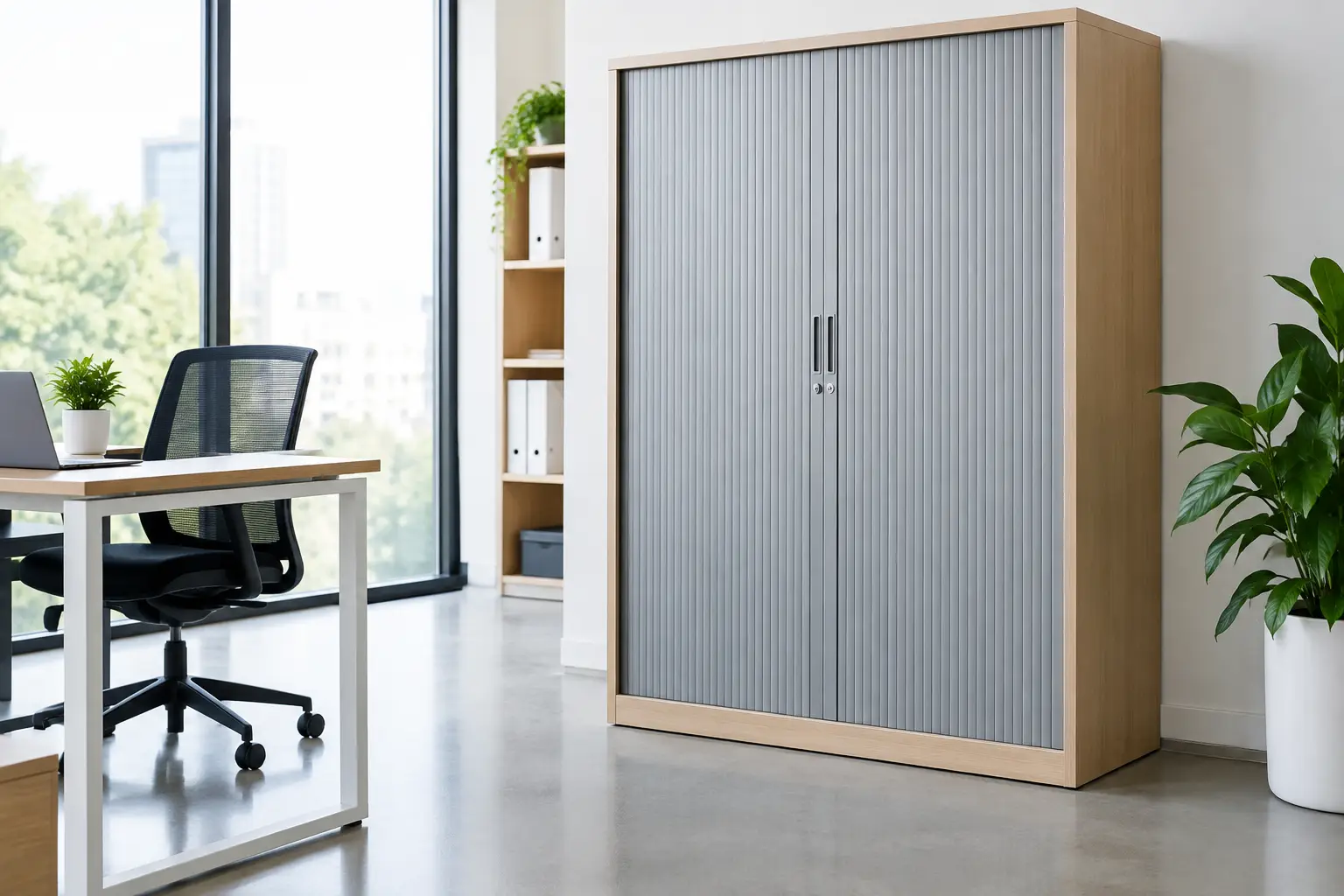
A roller door cupboard solves a practical problem that conventional swing-door cabinets cannot: storage access in tight working areas. Where an open door could block an aisle, workstation, or emergency route, a roller shutter moves within the cabinet structure. For offices, workshops, schools, healthcare facilities, and commercial fit-outs, that difference can improve both daily access and space planning.
The right unit is not simply a cabinet with a different door style. Door construction, cabinet steel, locking method, internal layout, and installation conditions all affect whether it will perform reliably under commercial use.
Why Choose a Roller Door Cupboard?
Roller door cupboards are designed for locations where floor clearance matters. Instead of doors projecting into the room, the shutter slides along side tracks and retracts into the cabinet body. Staff can access files, equipment, consumables, or supplies without creating an obstruction in a corridor or between closely arranged desks.
This design is particularly useful in high-density offices, records rooms, laboratories, reception areas, production offices, and shared workspaces. It also creates a cleaner front profile when cabinets are installed in continuous runs along a wall.
The trade-off is that roller mechanisms need to be specified well. A poorly made shutter can bind, rattle, or wear prematurely. For business buyers, the focus should be on a cabinet engineered for repeated operation, not only on its appearance at installation.
Key Specifications That Affect Performance
A cupboard may look similar in a catalog while differing significantly in service life. Procurement teams should assess the cabinet as a complete storage system.
Steel construction and finish
For demanding facilities, metal construction offers the strength required for regular loading, cleaning, and relocation. Cabinet body thickness, reinforced shelves, welded or securely assembled structural points, and stable base design all contribute to durability.
A powder-coated finish is a practical requirement in most commercial environments. It provides a consistent surface that is easier to maintain and more resistant to scratches than basic painted finishes. Color selection can also support department zoning, corporate interiors, or visual organization in shared storage areas.
Shutter design and guide tracks
The shutter is the working component that distinguishes this product type. Look for rigid interlocking slats or a purpose-designed tambour shutter that runs smoothly in durable guide tracks. The mechanism should open and close without excessive force, even when the cupboard is fully loaded.
Ask how the door performs over repeated cycles and whether replacement parts can be supplied if a shutter, track, or lock requires service. This is especially relevant for facilities with multiple users or a long replacement cycle for furniture.
Shelf capacity and adjustability
Internal storage should match the items being stored. Adjustable shelves provide flexibility for binders, boxed records, tools, IT accessories, cleaning stock, uniforms, and general supplies. Fixed shelf positions can be appropriate when the stored contents are standardized, but adjustable configurations usually give facility teams more long-term value.
Shelf load capacity matters as much as the number of shelves. Paper archives, hardware, and equipment can become heavy quickly. Confirm the safe distributed load per shelf and avoid specifying a general office cabinet for industrial materials that require heavier-duty storage.
Locking and access control
A roller door cupboard can serve as both an organizational and security product. Standard key locks are suitable for many offices, while master-key arrangements can simplify access across departments. Facilities with higher accountability requirements may need combination, digital, or electronic locking options.
The lock should secure the shutter effectively without weakening the operating experience. It should also fit the management process of the site. A cabinet used by one department needs different access control from a cabinet shared by rotating staff, contractors, or multiple shifts.
Selecting the Right Size and Layout
Start with the available footprint, but do not stop there. Measure the full location, including wall clearance, ceiling restrictions, skirting, power points, columns, and access routes for delivery. A cabinet that fits on a floor plan may still be difficult to position if it cannot pass through doors, elevators, or narrow internal routes.
Height determines storage volume, but it also changes usability. Tall cabinets maximize vertical capacity and work well for archived files or lower-frequency supplies. Mid-height cupboards can provide a useful worktop for printers, labeling stations, or shared equipment. Low units are often selected beneath windows or as part of a workstation layout.
Width and internal shelf arrangement should reflect what employees retrieve most often. A deep cabinet may hold more stock, but it can be inefficient for small items that become difficult to see and manage. For supplies with frequent picking, several well-organized cupboards may work better than one oversized unit.
Where Roller Door Storage Delivers Value
In administrative environments, roller cupboards keep documents, stationery, and shared equipment protected without taking up aisle space. They are particularly effective where desks are compact and storage must remain close to users.
In industrial offices and production support areas, they can hold manuals, inspection tools, PPE issue stock, and work instructions in a controlled location. Metal construction is better suited to these active environments than lightweight office furniture.
Schools, training centers, and public facilities benefit from secure storage that does not create door hazards in busy rooms. In healthcare and laboratory support spaces, cabinets can help organize non-sensitive supplies, provided the selected material, cleaning requirements, and storage contents are appropriate for the application.
For commercial fit-out projects, a coordinated bank of roller door cupboards gives designers a tidy storage line while allowing the buyer to specify dimensions, finish, shelves, and locks around the operational brief.
Standard Products or Custom Manufacturing?
A standard cabinet is often the most efficient choice when dimensions, color, and internal layout already fit the requirement. It can simplify purchasing and support faster delivery, particularly for repeat orders across several sites.
Custom manufacturing becomes valuable when the project has restricted dimensions, nonstandard shelf loads, specific colors, integrated lock requirements, or a need to match other metal furniture. It is also useful when a cabinet must support a defined workflow rather than general storage.
Customization should be based on a clear operational need. Special dimensions can improve every day use, but unnecessary variation can add cost and make future replacements harder to manage. The best specification balances fit, durability, lead time, and consistency across the facility.
Loxmet supports both standard metal storage products and project-based fabrication, helping buyers align roller cupboards with wider requirements for lockers, office cabinets, shelving, and workplace storage.
Installation and Care Considerations
Place the cabinet on a level surface so the shutter tracks remain aligned. Uneven floors can affect smooth movement over time, especially in tall units. Where site conditions or cabinet height require it, secure the unit according to the manufacturer’s installation guidance.
Routine care is simple but should not be ignored. Keep tracks free from dust and loose packaging material, avoid forcing a shutter that has been obstructed, and distribute shelf loads evenly. Do not overload shelves or use the cabinet as a climbing surface.
Facility managers should also assign responsibility for keys or access credentials. A secure cabinet becomes less useful when keys are untracked or when no process exists for reporting damaged locks and shutters.
Questions to Ask Before Ordering
Before requesting a quote, define the cabinet’s intended contents, required internal dimensions, shelf load, preferred lock, color, and quantity. Confirm whether the space requires wall fixing, whether delivery routes can accommodate the assembled cabinet, and whether future expansion is likely.
For multi-site purchasing, standardize the specification wherever possible. Consistent dimensions and locking arrangements reduce administration, simplify replacement planning, and give users the same storage experience across locations.
A roller door cupboard earns its place when it makes storage easier to access, safer to operate, and more efficient to manage. Specify it around the work performed in the space, and it can remain a dependable part of the facility for years.