


Highlights
Tall Storage Cabinet With Sliding Doors for Workplaces

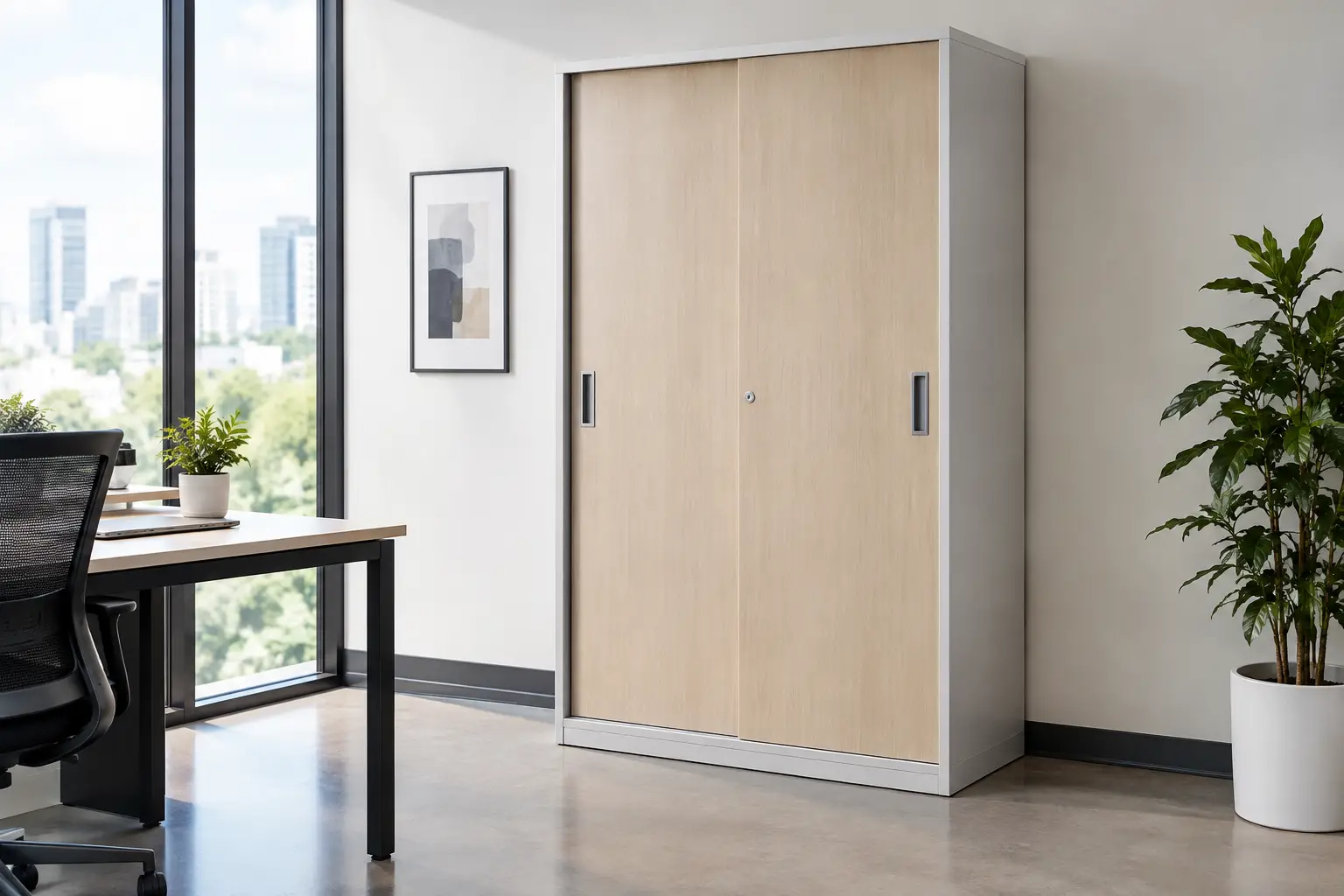
A tall storage cabinet with sliding doors solves a practical problem found in offices, workshops, schools, healthcare facilities, and industrial sites: storage must grow without taking over the aisle. Where swing doors need clear floor space to open, sliding doors keep access within the cabinet footprint. That difference can determine whether a storage layout works safely and efficiently.
For commercial buyers, the right cabinet is not simply a matter of height and color. It must carry the intended load, fit the available space, support secure daily access, and remain reliable after years of use. Selecting well at the specification stage prevents blocked walkways, damaged door tracks, inadequate shelf capacity, and avoidable replacement costs.
Why Sliding Doors Work in High-Density Layouts
Tall cabinets make use of vertical space that is often underused. They provide substantial capacity for files, tools, consumables, PPE, cleaning supplies, spare parts, or staff equipment while using a relatively small floor area. Adding sliding doors makes that capacity easier to place in narrow rooms and active work zones.
A hinged door can extend into a corridor, workstation, or adjacent cabinet bay. This creates conflicts in compact offices, stockrooms, production areas, and changing facilities. Sliding doors move laterally across the cabinet face, so personnel can retrieve items without stepping back to allow door clearance. For facilities with frequent traffic, this supports safer circulation and a cleaner layout.
There is a trade-off. With a conventional two-door sliding arrangement, only part of the cabinet interior is open at one time. If staff need full-width, simultaneous access to every shelf, hinged doors may be more appropriate. In most general storage applications, however, the floor-space advantage of sliding doors outweighs this limitation.
Specify the Cabinet Around the Stored Items
The best cabinet begins with a clear inventory. A cabinet used for archive boxes has different demands than one holding power tools, uniforms, laboratory supplies, or maintenance parts. Procurement teams should define not just what is being stored now, but what is likely to be stored over the cabinet’s service life.
Measure More Than Overall Height
Overall cabinet dimensions are only the first check. Measure the installation wall, ceiling height, aisle width, and any obstructions such as pipework, electrical panels, radiators, or doorways. Confirm that the cabinet can be delivered through access routes and positioned without dismantling other equipment.
Internal shelf width, depth, and clear vertical opening matter just as much. Deep shelves can accommodate bulky cartons but can also make smaller items harder to see and retrieve. A tall unit with adjustable shelves offers more flexibility when inventory changes, while fixed shelf positions may be suitable for standardized files or containers.
For safety and usability, avoid placing heavy items on upper shelves. A tall cabinet should be planned so dense stock, tools, or boxed materials remain lower down. Frequently used items should sit between knee and shoulder height where possible.
Match Shelf Capacity to Real Loads
Shelf load capacity should be assessed per shelf and for the cabinet as a complete unit. Buyers should account for the combined weight of items, containers, and any equipment stored inside. Paper records, metal components, liquid containers, and tool cases can become heavy quickly when stacked across a wide shelf.
Do not assume that a cabinet designed for office supplies will suit industrial stock. Heavy-duty steel construction, properly formed shelves, stable uprights, and secure shelf supports are essential where loads are substantial or access is frequent. Ask for clear load information and use the cabinet within its specified limits.
If items are unusually dense, oversized, or irregular, custom shelf spacing and reinforced shelf construction may be justified. This is often more cost-effective than adapting standard furniture after installation.
Construction Details That Affect Service Life
Metal cabinets can look similar in a catalog while performing very differently in service. The gauge and grade of steel, welding quality, door alignment, finish, and internal reinforcement all influence long-term reliability.
A commercial cabinet should have a rigid body that remains square under normal loading. Poor rigidity can lead to doors that bind, inconsistent gaps, and reduced locking performance. Look for formed steel components, durable joints, and a stable base designed for the operating environment.
The sliding mechanism deserves close attention. Doors should travel smoothly, align correctly when closed, and resist derailment during routine use. A well-designed track system protects the door movement from dust and everyday impacts. In workshops and industrial settings, where airborne debris is more common, routine cleaning of tracks should be included in facility maintenance.
Powder-coated steel is a practical finish for many workplaces because it provides a clean, durable surface that is straightforward to maintain. The required finish depends on the environment. A dry administrative office and a humid service area do not place the same demands on metal furniture. Where corrosion exposure, cleaning chemicals, or high-contact use are expected, specify the finish accordingly.
Security, Access, and Internal Organization
A tall storage cabinet with sliding doors should protect inventory without slowing down authorized users. The appropriate lock depends on who needs access and how often access changes. A central locking system may suit shared departmental supplies, while keyed-alike or master-keyed arrangements can simplify facility control across multiple cabinets.
For higher-value contents, consider the cabinet’s lock housing, door overlap, and overall resistance to forced opening. Security is not only about the lock itself. Doors must close accurately, and the cabinet body must support the locking point without excessive flexing.
Internal organization has a direct effect on operational efficiency. Adjustable shelves, dividers, labeled bins, hanging rails, and file supports can turn a large cabinet into usable storage rather than a place where stock disappears behind other stock. This is especially useful for maintenance stores, PPE distribution areas, office records, and shared supply rooms.
Where several teams use the same cabinet, establish ownership and replenishment rules. A quality cabinet improves storage capacity, but it cannot solve poorly managed inventory on its own.
Installation and Stability Requirements
Tall furniture requires a stable installation plan. Floor condition, wall construction, seismic requirements, loading pattern, and cabinet height all affect whether anchoring is necessary or recommended. Even when a cabinet appears stable when empty, loading the upper shelves or opening doors can change its center of gravity.
Facilities should follow the manufacturer’s installation instructions and use suitable fixings for the wall or floor substrate. Cabinets must be level so sliding doors run correctly and lock components align. In banks of cabinets, consistent spacing and alignment improve both appearance and daily operation.
Do not position cabinets where they restrict access to emergency equipment, electrical controls, exits, or service panels. In workplaces with forklifts, carts, or mobile equipment, consider impact exposure and provide protection where needed.
Standard Cabinets or Custom Fabrication?
Standard cabinets are often the right choice when time, budget, and application are straightforward. They offer predictable dimensions, faster procurement, and simpler replacement planning. For offices, staff rooms, general storerooms, and common facility supplies, a standard tall cabinet can meet requirements efficiently.
Custom fabrication becomes valuable when the storage environment has unusual dimensions or a defined operating process. A project may require non-standard widths, specific shelf quantities, integrated compartments, specialized locks, ventilation, a particular finish, or a configuration that aligns with existing furniture and workflow.
This decision should be based on operational value, not appearance alone. If customization reduces wasted space, protects equipment, improves access, or avoids a future reconfiguration, it can be a sound commercial decision. Loxmet supports both standard metal storage solutions and custom production for facilities that need a cabinet built around the application.
Questions to Settle Before You Order
Before issuing a purchase order, confirm the intended contents, maximum shelf and total load, external and internal dimensions, access route, locking requirement, finish, installation method, and delivery timing. For larger projects, request consistent specifications across all units so replacement parts, keys, and maintenance procedures remain manageable.
Also consider how the cabinet will be used five years from now. Storage demands tend to expand, departments change, and facilities are reorganized. A properly specified tall cabinet with adjustable internal capacity and durable sliding doors gives the operation room to adapt without consuming more valuable floor space.
The strongest storage purchase is the one that quietly supports work every day: doors that move correctly, shelves that hold their load, access that stays controlled, and a layout that leaves people enough room to do their jobs.