


Highlights
How Many Lockers Fit in a 20ft Container or 40ft Container?

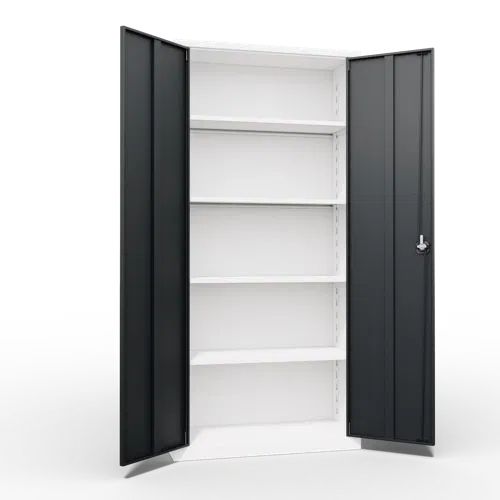
How many lockers fit in a 20ft container depends on the locker dimensions, loading direction, stacking method and available internal space. For this calculation, we use Loxmet’s assembled and welded Standard Size Locker Single Tier 2 Door as the reference product.
The result is clear:
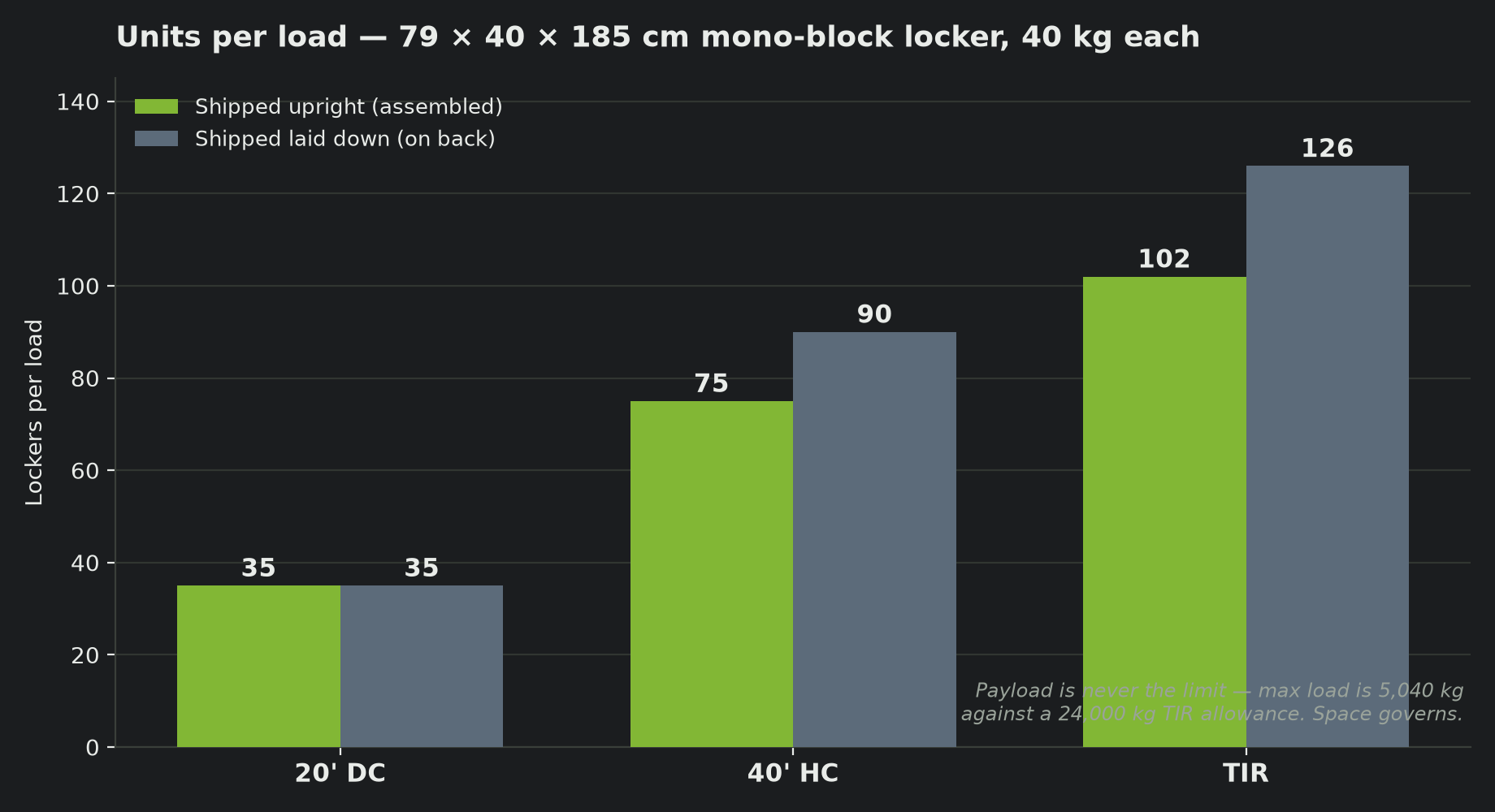
- 20' DC: 35 lockers upright or laid down
- 40' HC: 75 lockers upright or 90 laid down
- Standard TIR: 102 lockers upright or 126 laid down
The reference locker measures 79 cm wide × 40 cm deep × 185 cm high and weighs 40 kg per unit. It has an assembled mono-block body, arrives ready to use, and can be stacked without pallets.
| Carrier | Internal volume | Units loaded upright | Units loaded laid down | Total weight at maximum | Governing constraint |
|---|---|---|---|---|---|
| 20' DC | 31.1 m³ | 35 | 35 | 1,400 kg | Space, not weight |
| 40' HC | 72.7 m³ | 75 | 90 | 3,600 kg | Space, not weight |
| Standard TIR | 90.0 m³ | 102 | 126 | 5,040 kg | Space, not weight |
Internal volumes are calculated from the net interior dimensions stated in this article.
Container Capacity Chart: 20ft, 40ft and TIR
The chart below compares the two loading configurations using the supplied dimensions and verified unit counts.
- Upright loading: 35 / 75 / 102 units
- Laid-down loading: 35 / 90 / 126 units
The calculated geometric volume utilisation is:
- 20' DC: 65.8%
- 40' HC: 72.4%
- TIR: 81.9%
These percentages are based on locker volume against the supplied net interior volume. They do not represent guaranteed operational loading efficiency after protective materials, securing, door clearances, or mixed products are added.
Why Container Maths Matters Before You Order
Container loading affects more than freight cost. It influences your purchase quantity, landed cost per locker, customs documents, warehouse planning, and delivery schedule.
If you order 75 lockers for a 40' HC container but the selected loading method allows 90 units, you may pay for unused space. If you plan 126 lockers for a TIR without confirming handling protection, the extra volume may create avoidable damage risk.
A clear loading plan helps you:
- Compare container and truck freight costs
- Select a practical order quantity
- Calculate landed cost per locker
- Avoid unused space
- Prepare accurate packing lists
- Confirm whether pallets are necessary
- Plan unloading at your warehouse
- Mix standard products with confidence
For the complete product specification, see the Loxmet Standard Size Locker Single Tier 2 Door.
How Many Lockers Fit in a 20ft Container? The Three-Step Calculation
The calculation follows three steps.
1. Floor Plan First
The locker footprint is placed inside the available container floor area. The best orientation is selected according to the product dimensions.
For upright loading:
- Locker footprint: 79 cm × 40 cm
- Locker height: 185 cm
For the 20' DC:
- 7 lockers along the 580 cm length
- 5 lockers across the 233 cm width
- 7 × 5 = 35 lockers
For the 40' HC:
- 15 lockers along the 1200 cm length
- 5 lockers across the 233 cm width
- 15 × 5 = 75 lockers
For the TIR:
- 17 lockers along the 1360 cm length
- 6 lockers across the 245 cm width
- 17 × 6 = 102 lockers
2. Stacking Check
Laying the locker down changes the footprint and permits stacking where the available height allows it.
The verified laid-down results are:
- 20' DC: 15 per layer, reaching a 35 maximum across stacked and partial upper layers
- 40' HC: 30 per layer × 3 layers = 90
- TIR: 42 per layer × 3 layers = 126
The 20' DC receives no quantity benefit from the laid-down configuration. The 40' HC gains 15 lockers, while the TIR gains 24 lockers.
3. Payload Check
The unit weight is 40 kg.
The maximum calculated loads are:
- 35 lockers × 40 kg = 1,400 kg
- 75 lockers × 40 kg = 3,000 kg
- 90 lockers × 40 kg = 3,600 kg
- 102 lockers × 40 kg = 4,080 kg
- 126 lockers × 40 kg = 5,040 kg
Payload does not govern any of these scenarios. Even the heaviest result, 5,040 kg in a TIR, is well below a typical 24,000 kg allowance. Actual permitted payload must still be confirmed for the selected equipment, route, and carrier.
The 20' DC Answer: 35 Lockers
A 20' DC container has the supplied net internal dimensions of:
- 233 cm width
- 580 cm length
- 230 cm height
The upright plan loads 35 lockers in one layer. The laid-down loading plan also reaches 35 lockers, so there is no quantity improvement from placing the lockers on their sides.
For a straightforward export shipment, upright loading is the preferred recommendation for the 20' DC. It is easier to handle, easier to secure, and avoids additional loading risk around doors and frames.
Maximum product weight:
35 lockers × 40 kg = 1,400 kg
The 40' HC Answer: 75 or 90 Lockers
A 40' HC container provides:
- 233 cm width
- 1200 cm length
- 260 cm height
Upright loading gives 75 lockers.
Laid-down loading gives 90 lockers, using three stacking layers. This is a useful increase for importers who are optimising locker shipping volume and freight cost per unit.
However, the higher count is not automatically the best commercial choice. The locker is an assembled, welded mono-block unit. When laid down, the door edge and frame can carry load during stacking and handling. Protective edging, careful securing, and a suitable loading method are required.

Maximum product weight at 90 units:
90 lockers × 40 kg = 3,600 kg
The TIR Answer: 102 or 126 Lockers
The standard TIR dimensions supplied for this calculation are:
- 245 cm width
- 1360 cm length
- 270 cm height
Upright loading gives 102 lockers.
Laid-down loading gives 126 lockers, with three stacking layers. This is the highest unit count in the comparison and produces the best calculated geometric loading efficiency at 81.9%.
Maximum product weight:
126 lockers × 40 kg = 5,040 kg
TIR truck capacity varies according to the trailer body, internal fittings, axle restrictions, and road regulations. The same applies to 40ft container capacity, which can shift with the equipment type, door clearance, and any internal fittings. Use the stated dimensions as a planning basis, then confirm the actual trailer before loading.
Upright or Laid Down?
Upright Loading
Upright loading is the standard recommendation because it:
- Keeps the locker in its normal position
- Reduces pressure on door edges and frames
- Simplifies handling at destination
- Requires less protective material
- Makes inspection and unloading easier
- Reduces the risk of cosmetic damage
Laid-Down Loading
Laid-down loading is the volume option. It increases the count in the 40' HC and TIR:
- 40' HC: 90 instead of 75
- TIR: 126 instead of 102
It does not increase the 20' DC result.
Because these are ready-to-use welded lockers, the laid-down method must include proper protection. The final loading plan should confirm door-edge protection, stacking sequence, securing points, and unloading equipment.

What Reduces Real-World Capacity?
The figures above use net internal dimensions and no working gap between units. Real shipments can produce a lower count because of:
- Protective carton edging and stretch packaging
- Extra clearance at the container doors
- Load-securing materials
- Mixed locker models
- Pallets or skids
- Special colour or accessory packaging
- Sloping tops, benches, or loose components
- Carrier-specific internal restrictions
- Unloading and safety requirements
Loxmet normally supplies bubble nylon stretch and carton edging. For larger export orders, ask how the chosen packaging method affects the units per container before you confirm the order quantity. Pallet packaging is available upon request and may add cost and dimensional space.
Container dimensions and ratings should be checked against the applicable ISO 668 series 1 freight container standard and ISO 1496-1 general-purpose container specification. For export documentation and customs procedures from Turkey, consult the Turkish Ministry of Trade Export Regime guidance.
How to Plan Your Order Around Container Capacity
Start with your preferred loading position.
For the reference locker, practical planning quantities are:
- 35 units for a 20' DC
- 75 units for a 40' HC with upright loading
- 90 units for a 40' HC with approved laid-down loading
- 102 units for upright TIR loading
- 126 units for approved laid-down TIR loading
Then confirm whether your order includes one model or a combination. Different widths, heights, depths, benches, and accessories change the loading plan.
Loxmet offers more than standard single-tier lockers. You can compare options in the Standard Size Lockers category or review the wider Loxmet Locker range.
For mixed orders, ask for:
- Product code and quantity for each model
- External dimensions and unit weight
- Upright and laid-down loading options
- Packaging method
- Pallet requirement
- Container or truck type
- Estimated total load weight
- Recommended securing method
- Loading photographs or a diagram
- Final packing list quantity
How to Ask a Supplier for a Loading Plan
Send the supplier your destination country, preferred carrier, required products, quantities, and whether pallets are required.
Ask directly:
Please prepare an itemised loading plan showing the number of units, loading position, stacking layers, packaging dimensions, total weight, and remaining space.
A professional loading plan should distinguish between theoretical maximum capacity and the recommended commercial load. It should also state whether the figures assume no working gap, no pallets, or special protection.
Loxmet can prepare this calculation for standard or custom products. If your dimensions are different, use the custom metal locker and cabinet service to send your requirements for review.
Direct Answers for Importers
How many lockers fit in a 20ft container?
For the Loxmet single-tier 2-door locker, 35 units fit in a 20' DC when loaded upright. The laid-down result is also 35 units.
How many lockers fit in a 40ft container?
A 40' HC fits 75 units upright or 90 units laid down, subject to suitable protection and securing.
How many lockers fit in a TIR truck?
The calculated capacity is 102 units upright or 126 units laid down.
Does weight ever limit a locker shipment?
Not in this example. The maximum calculated load is 5,040 kg, so available space governs before payload.
Should lockers be shipped upright or laid down?
Upright loading is the standard recommendation. Laid-down loading is the volume option and requires proper door-edge and frame protection.
How much does a container of lockers weigh?
The product load weighs 1,400 kg for 35 units, 3,000 kg for 75 units, 3,600 kg for 90 units, 4,080 kg for 102 units, or 5,040 kg for 126 units. Packaging adds some additional weight.
Can mixed locker models share one container?
Yes. Mixed models can share one container, but the final quantity must be recalculated using each product’s dimensions, weight, packaging, and stacking limits.
How much working space should be allowed?
This calculation allows no working gap. There is no single universal allowance for every loading method. Confirm the required clearance for packaging, securing, door operation, and unloading with the supplier and carrier before booking.
Plan Your Locker Shipment With Confidence
For this Loxmet reference product, space, not weight, is the governing factor. Choose 35 lockers for a 20' DC, 75 upright or 90 laid down for a 40' HC, and 102 upright or 126 laid down for a TIR.
Request a loading plan before you place your bulk order. Send Loxmet your product list, quantities, destination, and preferred carrier. Our team can prepare a practical loading calculation and quotation from the manufacturing facility in Istanbul, Turkey. If you are still comparing supply options, start with our guide on how to source metal lockers direct from a Turkish factory.
For ordering, delivery, warranty, pricing, and distributor information, visit the Loxmet FAQs or contact the sales team today.