

Highlights
Locker Manufacturer or Reseller? How to Tell Before You Order

Before you place an order, confirm who makes the lockers, which company will take responsibility, and whether the evidence matches the offer. This practical checklist helps importers and procurement managers assess a locker supplier before money moves. When you compare a locker manufacturer with an intermediary, ask for evidence that identifies the actual production site. Buying direct from the factory is one possible route, but the supplier should make its role clear either way.
| Evidence type | What it helps prove | Signal strength | How to verify |
|---|---|---|---|
| Live production walkthrough | A real production site and visible work in progress | Strong, if specific to your product | Ask to see the facility live and identify the stages shown |
| Signed sample and specification | The product requirements are understood and recorded | Strong for order control | Compare the sample and sheet with your purchase requirements |
| Certificates and legal documents | The named company and site covered by the documents | Useful when checked at source | Compare legal names and verify with the issuer |
| Export paperwork | Whether the seller and exporter are consistent across documents | Useful corroborating evidence | Compare names, product descriptions and shipment details |
| Company history and addresses | Whether the business record supports its manufacturing claim | Supporting evidence | Check official registries and compare addresses |
Why the Difference Matters Commercially
A manufacturer and a reseller can both be suitable suppliers. The difference is who controls production and who is accountable when an order needs attention.
- Price: A reseller may add a margin to the factory price. Compare the full quotation and the services included.
- Lead time: A factory schedules production. A reseller relays the schedule and depends on the factory’s updates.
- Accountability: Confirm which legal entity signs the contract, handles a warranty claim, and resolves a specification issue.
- Customization: A manufacturer can assess changes against its production process. A reseller usually passes requests to the maker.
- Reorders: A documented specification and direct production control can support more consistent repeat orders.
The locker manufacturer vs reseller decision is not about assuming one option is always better. It is about knowing who is doing the work and what you are paying each party to provide. A factory-direct arrangement can shorten the chain of communication, but you should still verify the specification, responsibility and terms in writing.
How to Verify a Locker Manufacturer Before You Pay
Use these checks in order. Request specific evidence tied to the locker model and order you are considering, not only general company material.
1. See the Facility and Product in Production
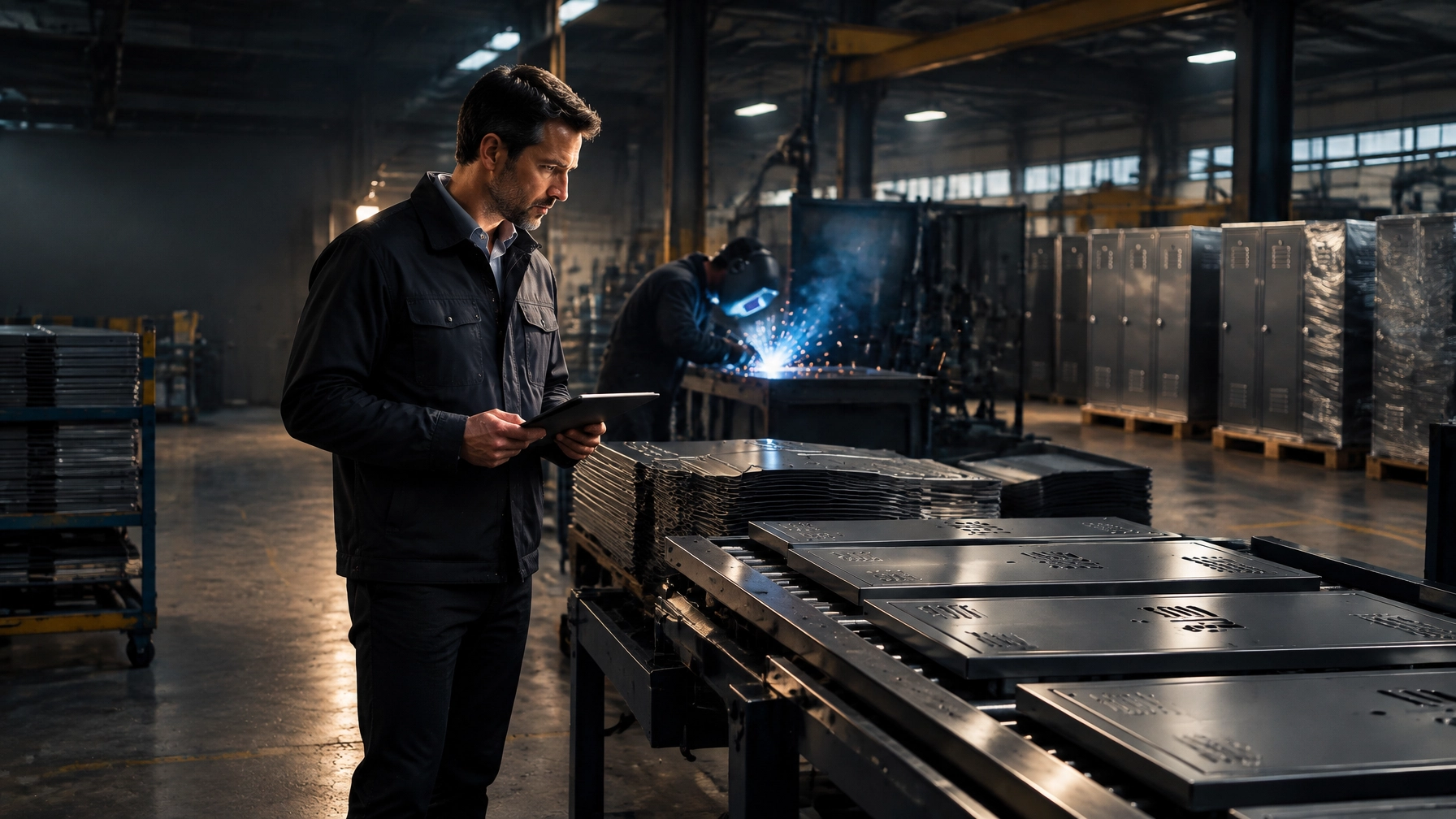
Ask for a live video walkthrough showing relevant production stages, such as cutting, bending, welding, coating, assembly and packing. Where possible, ask the supplier to show your product or its components in progress.
Look for clear, current evidence. A useful walkthrough connects the production location, staff, work in progress and product details. Dated photographs can support the review, but generic catalogue images do not establish that the supplier operates the facility.
Ask whether you can visit the factory or arrange an independent visit. A visit is a practical way to confirm the site and discuss the production process.

2. Match the Sample to a Written Specification
Request a signed pre-production sample approval and a specification sheet before production starts. The sheet should record the details that affect your order, including:
- Dimensions and door configuration
- Steel thickness for each component, such as body, doors and shelves
- Finish process and colour reference
- Lock type and keying requirements
- Internal fittings and accessories
- Packaging requirements
Ask who approves and signs the sample on the supplier’s side. Keep the signed version with the purchase order. For a broader shipment check, use the pre-shipment inspection checklist to connect approved requirements with production and dispatch checks.

3. Check Certificates Against the Legal Entity
Ask which legal entity holds each certificate and which production site it covers. Compare the name on the certificate with the name on the quotation, contract and invoice. If the names differ, ask the supplier to explain the relationship in writing.
Verify certificates with the issuing body or its official database. A logo on a website or catalogue is not enough. ISO explains the purpose of ISO 9001 quality management and ISO 14001 environmental management; certification alone does not establish that a particular order matches your specification.
4. Reconcile Export Documents
Ask which company will appear as seller and exporter on the order and shipment documents. Compare the legal names and product details across the quotation, invoice, packing list and other export paperwork. Ask about any difference before payment.
Confirm that the HS code shown on the documents suits the goods being shipped. The code can vary by product classification and destination requirements, so confirm it with your customs broker or relevant authority.
5. Check Company History and Addresses
Compare the registered company name and address with the supplier’s stated office and factory locations. A registered office and a production site can be different, but the supplier should explain the difference clearly.
For UK companies, use the official GOV.UK company information service to check available company details. In other countries, use the relevant official business registry. Registration supports identity checks; it does not, by itself, prove that a company manufactures lockers.
6. Identify Signals That Need More Questions
These signs are not proof that a supplier is a reseller or an unsuitable partner. They are reasons to request clearer evidence:
- A catalogue covering many unrelated product categories, with little manufacturing detail
- Quotations that omit steel thickness, finish, lock or other technical specifications
- Lead times without an explanation of production scheduling or stock availability
- Certificates issued to a different company or site, without a clear explanation
- Reluctance to show current production or identify the factory
- No written, per-component specification
A trading company may arrange production through a partner factory. If so, ask who makes your lockers, where production takes place, and which company is responsible for quality and warranty.
What a Factory-Direct Relationship Can Offer
A factory can assess changes as production decisions. That may include dimensions, door counts, locks, colours and internal fittings. It can also confirm whether a requested configuration is feasible and provide a production schedule based on the actual order.
Ask whether the supplier can retain your approved specification and keying records for reorders, and how it handles spare parts. These details matter when you need consistent repeat orders or future custom sizes. Buying direct from the factory may give you a direct route to discuss those changes with production, but still document the requirements and response in your order file.
For practical comparison, review the metal locker importer guide, the guide to sourcing metal lockers direct from a Turkish factory, and the custom metal fabrication service.
A good reseller can still be the right choice for a small mixed order, local stock or services that suit your purchasing needs. The key is to know whether you are buying factory-direct or through an intermediary, and to compare the responsibilities and service included.
Questions to Ask Before You Order
Ask these questions directly and keep the answers with your order file:
- Which legal entity manufactures the product?
- Which legal entity holds the certificates, and which sites are covered?
- Can you show live production of my product this week?
- What is the steel thickness for each component?
- Who signs the pre-production sample?
- Which company handles a warranty claim?
- Can you hold my specification for reorders?
If you need more prompts, see the questions to ask before buying metal lockers and confirm the applicable locker warranty terms.
Frequently Asked Questions
Is a locker supplier always the manufacturer?
No. A locker supplier may manufacture products, resell them, or coordinate production through another factory. Ask which company makes the lockers and which company will be responsible under your contract.
Is a trading company necessarily a poor choice?
No. A trading company can provide useful local stock, combined orders or coordination services. Confirm the original factory, the service provided, the product specification and the party responsible for claims.
What is the strongest evidence that a supplier manufactures lockers?
A live, product-relevant facility walkthrough is a strong initial signal. Compare it with the signed specification, sample, certificate details and export documents. No single item proves every part of the supplier’s claim.
Should certificates be in the same company name as the invoice?
Ask the supplier to explain any difference. Verify the certificate holder and covered site with the issuer, then confirm in writing how the certificate relates to the contracting and manufacturing entities.
Can a reseller arrange custom lockers?
Yes, a reseller can coordinate custom work with a factory. Ask to communicate with the production team where needed, approve a written specification, and identify who is accountable for changes and defects.
Is Loxmet a manufacturer or a reseller?
Loxmet states that it manufactures metal lockers and storage products at its facility in Istanbul, Turkey. The company also states that it holds CE, ISO 9001:2015, ISO 10002:2018, ISO 14001:2015 and ISO 45001:2018 certifications, and provides a 10-year warranty against production faults. Buyers can request the relevant company and certificate details and verify them with the issuing bodies.
What should I confirm before paying a deposit?
Confirm the contracting legal entity, approved product specification, payment beneficiary, production location, lead time, warranty process and any differences between the seller, manufacturer and exporter names. Put the agreed details in writing.
Confirm the Evidence Before You Order
Know who makes your lockers, who signs your documents and who will resolve an issue. Request the evidence, compare names and specifications, and record the answers before payment. For help evaluating a standard or custom order, contact the Loxmet team with your product list, destination and requirements.