


Highlights
Metal Locker Made in Turkey for trustable B2B

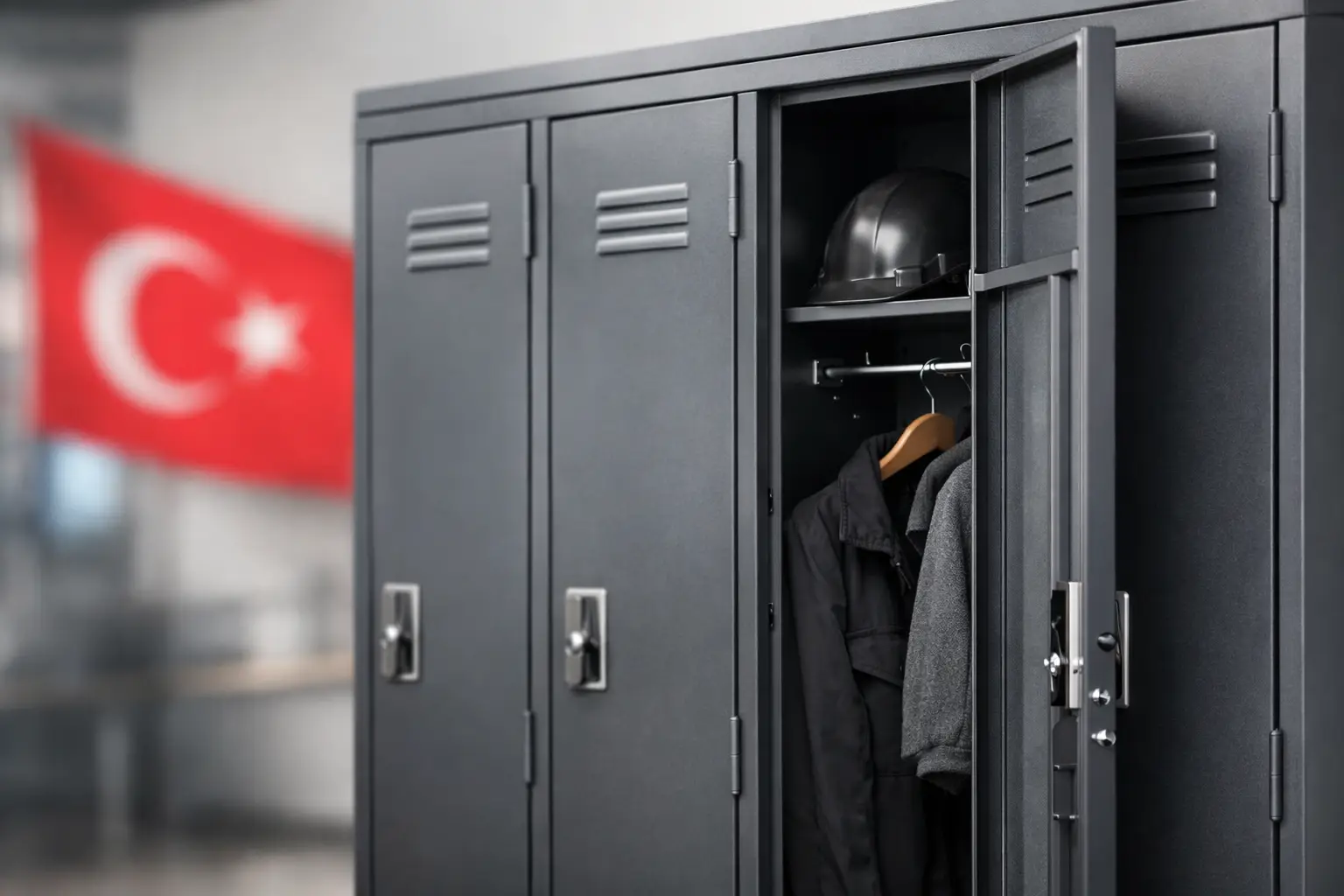
Procurement problems usually start after the order is placed. A locker may look right in a catalog, then arrive with thin steel, weak hinges, poor ventilation, or lead times that disrupt the entire fit-out schedule. That is why many buyers looking for a Metal Locker Made in Turkey are not just comparing price. They are evaluating manufacturing depth, consistency, customization, and delivery performance.
For business and institutional projects, lockers are working equipment. They protect personal items, uniforms, devices, documents, cleaning supplies, and PPE in environments that see daily use. Schools, offices, factories, gyms, healthcare facilities, and public buildings all need storage that stays functional under pressure. The supplier matters as much as the product.
Why buyers source metal lockers from Turkey
Turkey has become a strong manufacturing base for commercial metal furniture because it combines industrial production capability with practical export advantages. For international buyers, that often means more flexibility than buying from high-cost manufacturing regions and more consistency than relying on traders with limited factory control.
A serious Turkish manufacturer can usually offer three things that matter in real projects: broad product range, custom production capability, and commercially workable lead times. This is especially useful when a project includes more than standard employee lockers. Many buyers also need office cabinets, charging lockers, PPE storage, shelving, benches, or chemical cabinets within the same procurement cycle.
Cost is part of the decision, but it should not be the whole decision. A low unit price loses value quickly if the steel gauge is light, the powder coating fails early, or the design does not fit the actual use case. For distributors and project buyers, product reliability affects warranty claims, repeat orders, and installation timelines. That is where an experienced Turkish manufacturer can create more value than a low-cost source with limited production control.
What defines a good metal locker made in Turkey
Not every metal locker made in Turkey is built to the same standard. Buyers should look beyond surface appearance and review how the unit is manufactured, what options are available, and whether the supplier understands commercial use.
Material quality is the first checkpoint. Locker doors, body panels, shelves, and frames need to match the expected load and frequency of use. In office environments, the requirement may be moderate daily use. In industrial changing rooms or production sites, the locker may face hard handling, moisture, uniform storage, and continuous opening and closing. The build standard should reflect that reality.
Door stability is another point that gets overlooked until problems appear. Poorly reinforced doors can bend over time or lose alignment. Good lockers use a structure that keeps the door operating smoothly while maintaining secure closure. Locking options also matter. A project may require key locks, padlock compatibility, coin locks, digital access, or master key arrangements. A capable manufacturer should be able to adapt the configuration without turning every variation into a long engineering process.
Ventilation, shelf layout, and internal organization are equally practical concerns. Worker lockers need airflow. PPE lockers may need separated compartments. Charging lockers require safe cable routing and power integration. Small design choices affect how well the product performs once installed.
Metal Locker Made in Turkey for different sectors
The right specification depends on where the locker will be used. A standard one-size-fits-all model may work for simple applications, but many projects need tighter alignment between storage design and operational use.
In offices and administrative buildings, buyers usually prioritize clean design, secure personal storage, and efficient use of floor space. Multi-door locker systems are common where many users share limited square footage. The finish matters here because the locker is part of the visible workplace environment.
For factories, warehouses, and industrial sites, the focus shifts toward durability and function. Users may store uniforms, work boots, helmets, and tools. Ventilation, reinforced doors, and internal separation become more important. If the environment includes dust, moisture, or heavier daily wear, the locker should be built for that exposure rather than adapted from a light-duty office design.
In schools and training facilities, the main requirement is usually high-volume daily use. Lockers need to withstand repeated opening, impact, and changing user behavior over time. The design should also support quick maintenance and straightforward replacement planning for larger installations.
Gyms, sports facilities, and wellness spaces often need a balance between appearance and resistance to wear. Users expect smooth operation, clean surfaces, and reliable locking. Healthcare and PPE environments add another layer, where hygiene, compartment organization, and controlled storage are more important than simple personal item storage.
Customization matters more than buyers expect
Many projects fail at the specification stage because the locker selected is only close to what the site needs. Close is not always good enough. Dimensions, compartment count, door configuration, color, base type, lock option, labeling, and ventilation pattern can all affect usability.
For distributors and contractors, customization is not just a design preference. It is a way to reduce installation compromises and avoid future complaints. A locker bank that fits the room correctly, supports the right locking method, and matches the operational flow will perform better and require less correction after delivery.
This is one of the practical advantages of working with a manufacturer rather than a reseller. Factory-based production allows the buyer to discuss exact requirements and align them with what can be built efficiently. In project business, that shortens the gap between concept and production reality.
Loxmet operates in this space as a Turkish manufacturer focused on heavy-duty storage solutions, which matters for buyers who need standard models and custom fabrication from one supply partner.
What procurement teams should verify before ordering
A good quotation is only the starting point. Before placing an order, procurement teams should verify the product construction, the scope of customization, and the supplier’s production discipline.
Ask how the locker is intended to be used and whether the proposed model is standard duty or heavy duty. Review steel thickness, door reinforcement, locking alternatives, finish quality, and available accessories. If the project has compliance or safety requirements, confirm them early rather than after production begins.
Lead time should also be split into standard production and custom production. Some suppliers quote one general timeline that does not reflect actual factory scheduling. For project planning, buyers need realistic dates tied to the product type, quantity, and level of customization. Fast delivery for standard items is valuable, but only if the supplier can maintain consistency at volume.
Packaging and export readiness are equally important for international orders. Locker quality can be damaged by poor packing long before installation. Buyers should confirm how units are packed, shipped, labeled, and documented, especially for container orders or multi-item project shipments.
Balancing price, lead time, and long-term value
There is always a trade-off between budget, speed, and specification. The right choice depends on the project.
If the requirement is urgent and straightforward, a standard locker with limited customization may offer the best value. If the installation is part of a branded fit-out, a school expansion, or an industrial facility with defined worker storage needs, custom production often delivers better results even if the unit cost is higher.
The long-term cost of the wrong locker is usually hidden at first. It appears later as maintenance issues, replacement orders, user dissatisfaction, or delays in handover. For distributors, it may appear as warranty claims and lower confidence in future tenders. For facility operators, it shows up as a product that technically works but does not hold up to real usage.
That is why dependable manufacturing matters. A supplier with a wide standard catalog, low minimum order flexibility, and custom capability gives buyers more control over the purchasing decision. Instead of forcing the project to match the product, the product can be aligned with the project.
Choosing the right Turkish locker supplier
When evaluating a Turkish supplier, look for clear manufacturing focus rather than broad trading activity. A supplier that specializes in metal furniture and workplace storage will usually give stronger technical guidance than a company selling many unrelated product groups.
Range also matters. If the supplier can provide lockers, cabinets, shelving, benches, and specialized storage from the same production base, procurement becomes simpler. It reduces coordination time, helps maintain finish consistency across the project, and can improve shipping efficiency.
After-sales confidence is another signal. Warranty terms, product consistency, and responsiveness all indicate whether the supplier is built for long-term business or one-off transactions. For distributors in particular, reliability is part of margin protection.
A Metal Locker Made in Turkey is a smart sourcing option when the manufacturer can support commercial volumes, project customization, and durable day-to-day performance. The best results come from choosing a partner that understands how the locker will be used, how quickly it needs to ship, and how much dependability the project really requires.