


Highlights
How to Plan a Janitorial Storage Closet

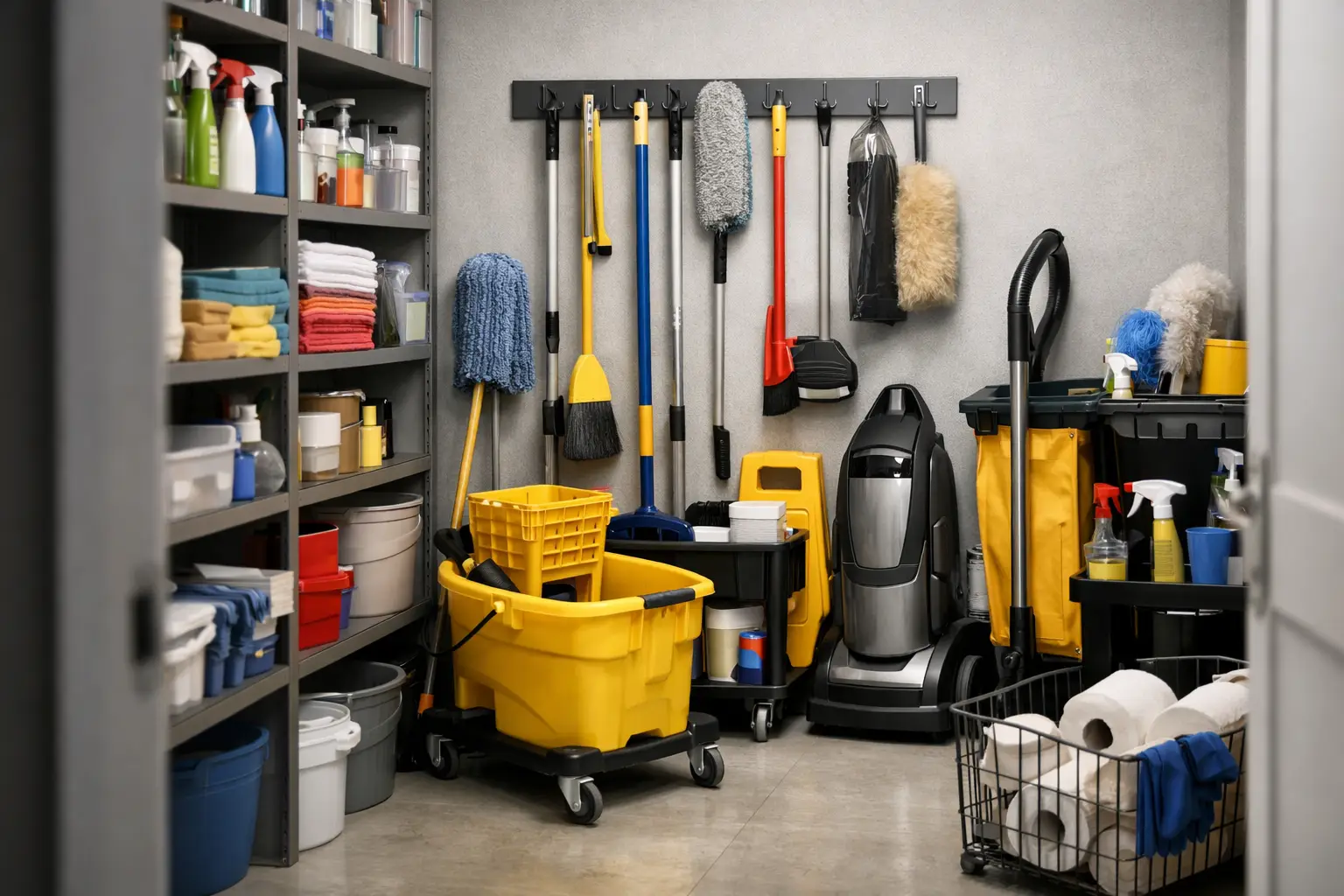
A janitorial storage closet usually becomes a problem long before anyone calls it one. Mops are stacked in corners, chemicals share shelves with paper goods, and basic supplies disappear because there is no defined layout. For facility managers, procurement teams, and fit-out professionals, that kind of disorder creates more than inconvenience. It slows cleaning operations, increases risk, and makes inventory control harder than it should be.
A well-planned closet supports labor efficiency, safety compliance, and longer product life. It also reduces the daily friction that cleaning teams deal with on every shift. The right setup is not just about fitting more inside a room. It is about giving every item a place, protecting hazardous materials, and making routine tasks faster.
What a janitorial storage closet needs to do
In commercial and institutional buildings, janitorial storage is a working system, not a passive room. Staff need fast access to consumables, secure storage for chemicals, and enough structure to keep wet and dry items separated. If the closet serves a school, hospital, office, hotel, factory, or public facility, the operating pattern changes, but the core requirements stay consistent.
The closet should support three functions at the same time. First, it must store daily-use items in a way that reduces retrieval time. Second, it must protect both staff and inventory through safe segregation and durable construction. Third, it should make stock visibility easier so teams can reorder before shortages affect service.
That balance matters because over-optimizing for one goal can create problems elsewhere. A closet packed for maximum capacity may become unsafe or difficult to use. A highly secure closet with poor shelf planning may protect materials but slow down every cleaning round. Good design is practical, not theoretical.
Start with workflow, not shelving
Many storage mistakes begin with product selection before anyone maps how the space will actually be used. A janitorial storage closet should be designed around workflow. That means understanding who uses it, how often, and what they need during a shift.
If staff collect supplies several times a day, frequently used items should sit at easy reach. If teams rely on carts, the entry width and turning space matter as much as shelf quantity. If chemicals are dispensed centrally, that changes the mix of cabinets and open shelving required. In smaller facilities, one closet may support all cleaning operations. In larger sites, it may act as a replenishment point for several floors or zones.
Usage volume should guide layout decisions. High-turn consumables such as paper products, liners, cloths, and soap refills need accessible storage with clear stock rotation. Long-handle tools need vertical organization so they do not fall or block access. Bulk reserve stock may justify heavier-duty shelving deeper in the room, while daily-use materials belong near the front.
Safe separation is not optional
This is where many closets fail. Cleaning chemicals, maintenance supplies, textiles, and consumables are often mixed together because there is available space. That approach may seem efficient in the short term, but it increases risk and weakens control.
Chemical products should be stored in dedicated metal cabinets suited to the materials being used and the facility’s safety procedures. Lockable storage is often necessary, especially in schools, healthcare facilities, hospitality settings, and public buildings. PPE should have its own defined location so staff can access it quickly and managers can check stock at a glance.
Wet items also need separation. Mops, buckets, and related tools can introduce moisture into enclosed storage areas, which affects hygiene and shortens the life of surrounding materials. Where possible, create a zone for drying and a separate zone for clean, dry inventory. The exact configuration depends on room size, but the principle stays the same: mixed storage creates avoidable problems.
Why metal storage performs better in janitorial areas
Janitorial spaces are hard on furniture. Surfaces are exposed to moisture, chemicals, repeated cleaning, impact from carts, and frequent handling. In that environment, light-duty materials often wear out quickly or lose shape over time.
Metal cabinets and shelving are a stronger fit because they are built for demanding use. They handle heavier loads, maintain structural stability, and provide better long-term value in commercial settings. Lockable metal cabinets also give facilities more control over chemical access and supply management.
There is also a maintenance benefit. Smooth, durable metal surfaces are easier to clean and better suited to controlled environments than storage that swells, chips, or degrades under repeated exposure. For buyers managing multiple sites, standardizing on heavy-duty metal storage can simplify replacement planning and improve consistency across projects.
Layout decisions that improve daily efficiency
A productive closet is usually organized by motion. Staff should be able to enter, collect what they need, and leave without moving obstacles or digging through mixed inventory. That sounds basic, but it depends on the right storage combination.
Wall-mounted or floor-standing shelving works well for boxed supplies and refill stock. Lockable cabinets are better for chemicals, controlled products, and items with higher misuse risk. Tall narrow storage can help in compact spaces, but only if it does not compromise visibility or safe access. In many projects, a mix of cabinets and shelving delivers better results than relying on one storage type for everything.
Labeling also matters more than many teams expect. Even durable, well-designed storage loses value if internal organization is vague. Clear zones, shelf labels, and restocking rules reduce dependence on individual staff habits. They also make onboarding easier when cleaning teams change.
If the closet serves multiple users or shifts, standardization becomes even more important. The goal is simple: any trained employee should be able to find, use, and return items without guesswork.
Capacity planning for a janitorial storage closet
Under-sizing is expensive because it leads to overflow, clutter, and off-site storage habits inside the building. Over-sizing can waste floor area that may be needed for other functions. The right answer depends on building type, cleaning frequency, and stocking strategy.
A facility that receives regular deliveries may need less reserve capacity than one that stocks larger volumes to reduce replenishment risk. Healthcare and industrial sites may also need additional controlled storage for specialized cleaning materials and PPE. Schools and office buildings often see demand spikes tied to occupancy patterns, which changes how much reserve stock should be held on-site.
This is one of those areas where standard products and customization both have value. Standard cabinet and shelving sizes often suit routine applications and support faster project timelines. But if the room has unusual dimensions, restricted access, or a specific safety requirement, custom metal fabrication can produce a better operational result. That is often the difference between furniture that fits the room and storage that actually improves the room.
Common buying mistakes
The most common mistake is treating the closet as leftover space rather than operational infrastructure. That usually leads to underspecified furniture, poor separation, and a layout that creates daily inefficiency.
Another mistake is buying only for current stock levels. If service frequency increases, building occupancy changes, or cleaning protocols expand, storage pressure rises quickly. Buyers should plan with reasonable growth in mind.
It is also risky to select storage based only on dimensions and price. Load capacity, lock options, corrosion resistance, shelf adjustability, and long-term durability all affect lifecycle value. A lower upfront cost can become expensive if cabinets fail early or no longer suit the application.
For distributors and project buyers, supplier consistency matters as much as product design. Lead times, repeatability, and the ability to customize for site requirements can determine whether a project stays on schedule.
Choosing storage that fits the facility
There is no single best configuration for every janitorial room. A compact office building may need a simple combination of shelving, a lockable chemical cabinet, and vertical tool storage. A large industrial site may require heavier-duty shelving, more secure segregation, and multiple cabinets for controlled materials. Hospitality and healthcare settings usually demand a higher level of order, access control, and cleaning discipline.
That is why product selection should start with the operating environment. Buyers should look at room dimensions, inventory types, traffic level, moisture exposure, and security needs before choosing storage. From there, the right combination becomes clearer.
For commercial projects, durable metal systems are typically the safest long-term choice because they support heavier use, tighter control, and better consistency over time. Manufacturers with both standard lines and custom production capabilities can usually solve space and specification challenges more efficiently. For example, Loxmet supports project buyers with heavy-duty metal storage solutions that can be matched to practical site requirements rather than generic room assumptions.
A janitorial storage closet works best when it disappears into the routine. Staff can find what they need, managers can see what is missing, and the room stays controlled without constant correction. That is usually the sign that the storage was planned properly from the start.