


Highlights
Slim Lockers for High-Density Storage

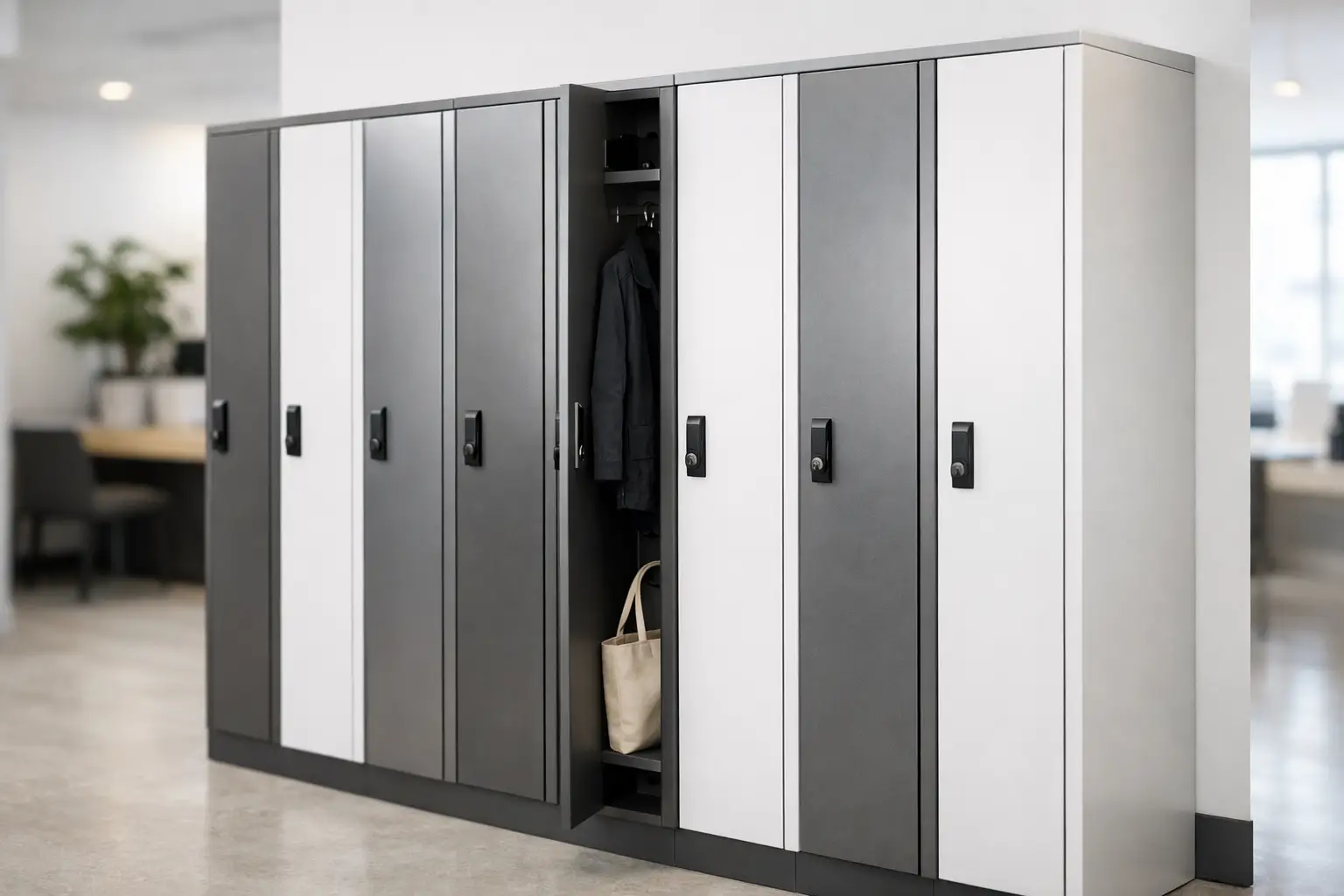
When floor space is limited, storage decisions become operational decisions. Slim lockers are not just a way to fit more doors into a room. They help facilities organize personal items, devices, uniforms, PPE, and small-value goods without giving up circulation space, safety clearance, or a clean layout.
For procurement teams, facility managers, and project buyers, that matters. A locker room, office corridor, staff entrance, school hallway, or production support area has fixed dimensions. Once benches, walkways, door swing, and code requirements are accounted for, every inch of usable storage width counts. Slim lockers are often the most efficient answer when standard-width compartments would reduce capacity or disrupt traffic flow.
Where slim lockers make the most sense
The best use case for slim lockers is simple: high user volume in a compact footprint. Staff changing areas, fitness facilities, schools, healthcare support zones, and shared office environments often need many individual compartments, but users only store smaller items. In these settings, full-width lockers can waste space.
A narrow compartment works well for bags, shoes, folded garments, laptops, tablets, helmets, documents, and personal belongings that do not require hanging height or broad shelf depth. That makes slim lockers especially practical for hot desk offices, clean room support spaces, parcel collection points, and employee phone storage.
There is a trade-off. If users need to store bulky coats, large backpacks, or workwear kits, going too narrow can create frustration. The right decision depends on what will actually be stored, how long items remain inside, and how often each compartment is accessed during the day.
Why buyers choose slim lockers
Space efficiency is the obvious reason, but it is not the only one. Slim lockers can improve layout flexibility across an entire site. Because each unit takes less width per compartment, planners can increase user count without adding rows that crowd walkways or force a redesign.
That matters in projects where building structure limits options. Columns, narrow corridors, shallow alcoves, and existing wall lengths often prevent the use of wider storage banks. Slim lockers allow specifiers to work with the room as it exists rather than overbuilding the solution.
They also support better compartment allocation. Instead of assigning one large locker to every user regardless of need, businesses can match storage volume to actual use. This can reduce idle space and improve locker availability in shared environments.
For distributors and project resellers, slim lockers are also easier to position across multiple sectors. The same narrow-footprint concept can serve education, office, industrial, wellness, and public facility projects with changes to locking type, ventilation pattern, internal fittings, and finish.
Slim lockers vs standard lockers
The decision is not just about width. It is about storage behavior.
Standard lockers are the better fit when users need hanging space, large personal item storage, or long-shift uniform changes. They offer more flexibility per person, but they reduce total compartment count. In lower-density environments, that is often acceptable.
Slim lockers work better when security, separation, and user quantity are the priority. They create more individual storage points in the same footprint. In a workplace with rotating staff or temporary users, that can be more valuable than oversized compartments.
Another difference is visual density. A wall of slim lockers creates more doors and more lock positions, which can be a benefit or a drawback depending on the design objective. In utilitarian settings, that usually supports the brief. In premium office or hospitality spaces, buyers may want to balance compartment count with a cleaner appearance.
What to check before specifying slim lockers
Compartment dimensions should be driven by use case, not assumptions. A laptop locker for office staff, a phone locker for production zones, and a PPE locker for safety equipment all have different width, height, and depth requirements. Small errors at the specification stage create daily problems once the units are installed.
Door strength is another critical point. Slim doors are narrower, but they still need rigidity, stable hinges, and dependable locking performance under frequent use. In high-traffic settings, weak doors quickly lead to misalignment, noise, and service calls.
Ventilation should match stored contents. Personal item lockers may need basic airflow. Gym and changing area applications often require more ventilation. PPE and workwear storage may need specific internal layouts rather than simply a narrow empty compartment.
Locking options also change the value of the product. Cam locks may suit low-complexity sites. Hasp locks give user flexibility. Digital or RFID access can support managed environments, shared usage, or audit requirements. The best lock is the one that fits the operating model, not the one with the longest feature list.
Material quality matters more in narrow formats
With slim lockers, manufacturing quality becomes more visible over time. Narrow doors and high door counts mean more hinges, more latch points, and more repetitive daily handling. If sheet metal thickness, reinforcement, welding quality, or coating consistency are not up to standard, wear shows quickly.
For commercial buyers, this is where industrial-grade production matters. Powder-coated steel construction, reinforced doors, stable body assembly, and consistent fabrication tolerances all affect service life. In project environments, especially where lockers are installed in rows, poor dimensional consistency can slow installation and create alignment issues across the bank.
Buyers should also look at finish performance. In dry offices, standard powder coating may be enough. In gyms, healthcare support areas, or semi-humid service spaces, corrosion resistance and easy-clean surfaces become more important. It depends on the operating environment, cleaning routine, and expected years of use.
Customization can make slim lockers more useful
Not every site needs a standard locker block. Some need mixed compartment sizes. Some need sloping tops for hygiene control. Others require integrated numbering, master key capability, ventilation choices, internal shelves, charging features, or color coding by department.
This is where a manufacturing partner adds value. Customization should not mean complexity for the buyer. It should mean the locker layout fits the workflow from day one. A narrow compartment with the wrong internal setup is still the wrong product.
In school projects, buyers may want high compartment counts with durable door identification. In industrial settings, they may need separate clean and dirty storage logic. In offices, the focus may shift toward compact personal storage with device charging. The footprint may be slim, but the specification still needs to be precise.
Installation planning is part of the purchase decision
Slim lockers are often selected to solve a space problem, but installation details can either protect that advantage or weaken it. Door opening clearance, wall fixing, leveling on uneven floors, row alignment, and access to cleaning areas all need to be considered before order confirmation.
In retrofit projects, this is especially important. Existing walls, HVAC grilles, electrical points, and circulation routes can affect the final configuration. A slightly different unit height, plinth option, or banking arrangement may improve the result without increasing cost.
For larger rollouts, repeatability is just as important as design. Procurement teams need confidence that the first batch and the next batch will match. That consistency supports phased projects, distributor supply, and future expansion.
Choosing a supplier for slim lockers
The product may look simple, but commercial performance depends on the supplier behind it. Buyers should assess manufacturing capability, standard range breadth, customization flexibility, lead time reliability, and after-sales consistency.
A supplier that understands project-based storage will ask the right questions early: what is being stored, how many users need access, what is the expected frequency of use, what locking system fits the site, and what installation constraints exist. Those questions prevent overspecifying or underspecifying the product.
For distributors and contract buyers, broad category coverage also helps. If a supplier can provide slim lockers alongside office cabinets, PPE storage, benches, and other metal storage systems, procurement becomes simpler and site standards are easier to maintain. That is one reason many international buyers work with manufacturers such as Loxmet for both standard models and tailored production.
Slim lockers are not the right answer for every application. But when the goal is to increase user capacity, protect circulation space, and keep storage secure in compact areas, they solve a real operational problem. The best result comes from matching compartment size, door durability, locking method, and layout to the way the facility actually works. That is where a good locker stops being a metal box and starts performing like equipment.