


Highlights
Lockable Office Cupboard with Sliding Doors

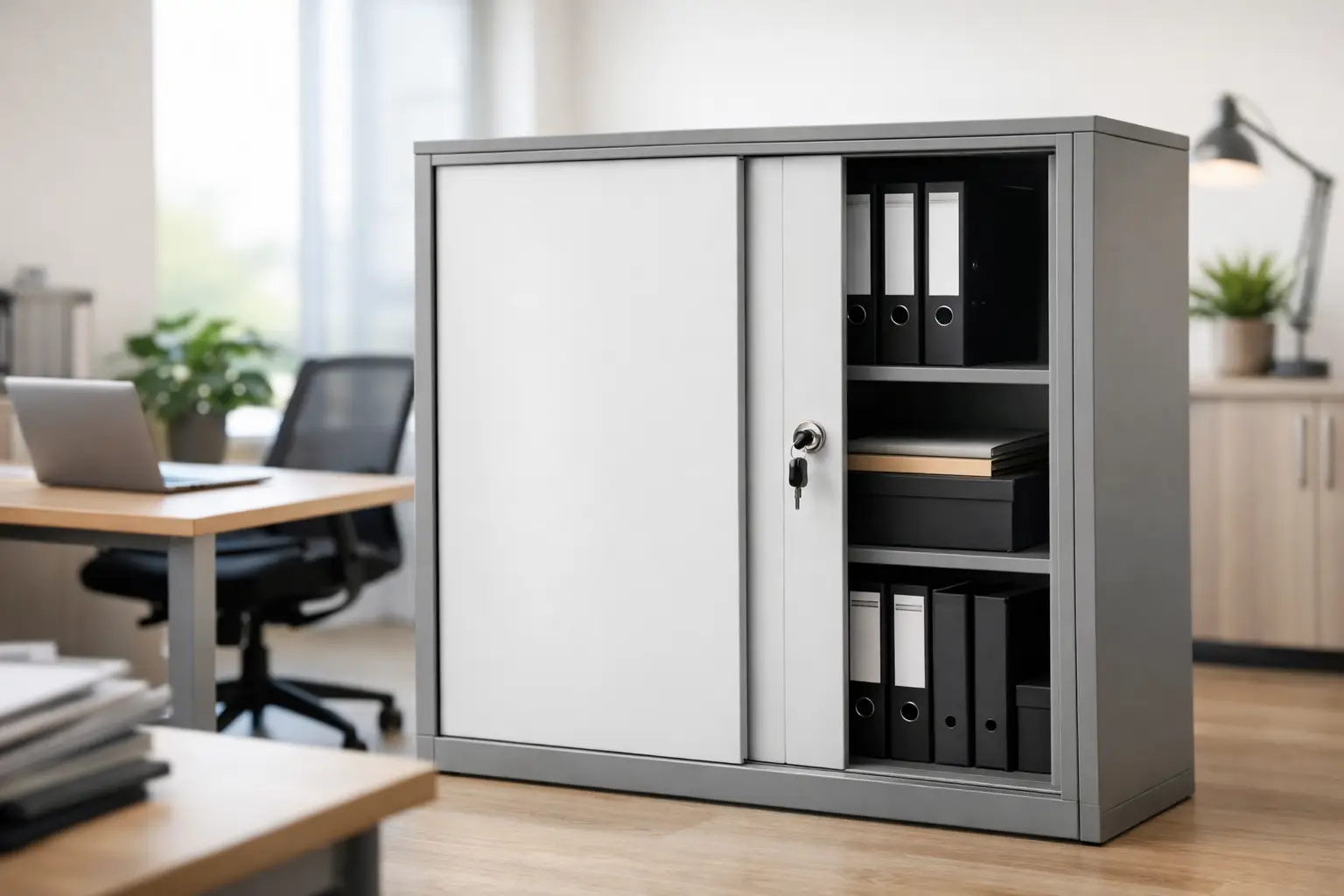
Aisle space disappears fast in busy offices. Open a hinged cabinet in a records room, admin area, or shared workspace, and suddenly the walkway is blocked. That is why a lockable office cupboard with sliding doors is often the better fit for commercial environments that need secure storage without wasting floor space.
For procurement teams, facility managers, and fit-out professionals, this is not a small detail. Door movement affects workflow, clearance planning, and day-to-day safety. Security matters too, especially when the cupboard is used for files, devices, controlled supplies, staff records, or departmental stock. A well-built sliding door cupboard solves both problems at once, but only if the specification matches the actual workload.
Why choose a lockable office cupboard with sliding doors
The main advantage is simple. Sliding doors do not swing into corridors, desks, or shared circulation areas. In compact offices, archives, schools, healthcare admin zones, and back-office rooms, that can make layout planning much easier.
There is also a practical advantage in high-frequency use. Staff can access stored items quickly without needing full front clearance. That matters when cabinets are placed opposite workstations, in narrow storage rooms, or along walls where movement is already limited.
The lockable aspect adds another layer of operational value. Not every office item needs full security, but many do. Personnel files, confidential documents, petty cash records, tablets, charging accessories, uniforms, visitor materials, and department-issued equipment all benefit from controlled access. A cupboard that combines physical security with efficient access is often more useful than a larger unit that creates space problems.
That said, sliding door cabinets are not automatically the right choice for every application. If users need the entire front opening at once for oversized archive boxes or bulky equipment, hinged doors may still be more convenient. The right decision depends on room constraints, access frequency, and what will actually be stored.
What buyers should look for in construction quality
In commercial settings, appearance matters less than consistent performance. A cupboard may look acceptable on delivery but still fail under daily use if the steel gauge is too light, the tracks are poorly aligned, or the lock system is basic.
A strong metal body is the starting point. For business buyers, welded or well-engineered assembled construction is usually preferred because it reduces cabinet movement over time. Door rigidity also matters. Thin sliding doors can flex, rattle, or misalign after repeated use, especially in shared offices or institutional environments.
Track design deserves close attention. If the sliding mechanism is weak, users notice it immediately. Doors should move smoothly, stay aligned, and resist jamming. In practice, this affects more than convenience. A poor track system creates maintenance issues, frustrates users, and shortens service life.
Lock quality should be assessed in the same way. A lockable cupboard is only as reliable as its locking point, cylinder quality, and key management setup. Depending on the environment, buyers may need keyed alike systems, master key compatibility, or higher control over duplicate keys. These details are often overlooked at quotation stage and raised later when installation is already complete.
The finish is another commercial issue. Powder-coated steel is usually the practical choice for office storage because it resists wear better than lower-grade painted surfaces. In multi-user spaces, durable finishes help the cupboard maintain a clean, professional appearance over years of use.
Size, layout, and internal configuration
A lockable office cupboard with sliding doors needs to fit more than the room. It also needs to fit the storage pattern. That is where many projects go wrong.
Tall cupboards increase vertical capacity and reduce the storage footprint, which is useful in offices where floor space is expensive. Lower cupboards can work better under windows, in print areas, or as combined storage and work surfaces. Width and depth should be selected based on the stored items rather than estimated visually.
Shelf adjustability is essential if contents are likely to change. Filing needs may shift to device storage, archived paperwork may be replaced by office supplies, and one department may inherit another department’s cabinet. Adjustable shelves protect that investment because the cupboard can be reconfigured rather than replaced.
Weight capacity matters as well. Paper records are heavier than many buyers expect, and metal cupboards often end up holding dense loads over time. A shelf that performs well with binders may not perform as well with archived files or boxed materials. Commercial buyers should confirm the safe load rating per shelf, not just overall dimensions.
Common use cases for sliding door cupboards
In general office environments, these cupboards are often used for secure document storage, stationery control, and department supplies. In schools and training centers, they can support staff-only storage in administrative spaces. In healthcare or laboratory-adjacent offices, they may hold controlled paperwork, consumables, and non-clinical supplies. In industrial facilities, they are useful in supervisor offices, maintenance administration areas, and parts documentation stations.
Each use case changes the specification slightly. A cabinet for archived records may need more shelves and higher load capacity. A cupboard for mixed office supplies may need fewer shelves and faster visual access. A cabinet for shared staff access may require a stronger lock strategy and more durable door guidance.
Security is not one specification
Many buyers ask whether a cupboard is lockable, but that is only the first question. The more useful question is whether the level of security fits the risk.
For routine office storage, a standard keyed cam lock may be sufficient. For controlled access applications, buyers may want central locking, reinforced lock areas, or master key arrangements for facility oversight. In larger projects, consistency across multiple cupboards can save time for administrators and reduce key management issues.
It is also worth separating privacy from real security. A basic lock prevents casual access, which may be enough for office supplies or internal documents. If the contents include sensitive records, valuable devices, or regulated materials, buyers should consider stronger cabinet construction and a more controlled locking system.
This is where working with a manufacturer rather than a generic reseller can be an advantage. The right supplier can adapt lock options, dimensions, shelf layouts, and finish choices to suit the project instead of forcing the buyer into one standard format.
When customization makes sense
Standard products cover many office needs, especially when fast delivery matters. But custom production becomes valuable when the cupboard needs to match exact room dimensions, internal storage requirements, or project finishes.
For example, a distributor may need a sliding door cupboard range in specific sizes for a regional market. A fit-out contractor may need cabinets in a defined color and width to align with a full office installation. A healthcare buyer may require a configuration that separates files from stored consumables. These are practical commercial adjustments, not cosmetic extras.
Loxmet works in this space because many business buyers need more than catalog availability. They need dependable metal construction, repeatable quality, and flexibility across both standard and project-based orders.
Buying considerations for procurement teams
Price always matters, but unit price alone is a poor comparison point for storage furniture used every day. A cheaper cupboard that jams, flexes, or needs early replacement usually costs more over the life of the project.
Lead time should be reviewed alongside specification. If the project requires immediate installation, a standard sliding door cupboard may be the right call. If the application is specialized, a short delay for custom production may produce a better long-term result. The decision depends on whether speed or exact fit is more valuable.
Warranty and after-sales confidence also deserve attention. Commercial buyers are not purchasing decorative furniture. They are purchasing an operational asset. Reliable manufacturing, clear specifications, and long service life are usually more important than minor savings at order stage.
For international buyers and distributors, supply consistency matters just as much. If a cabinet range performs well, the buyer needs confidence that future orders will match in build quality, dimensions, and finish.
A practical choice for compact, secure storage
A lockable office cupboard with sliding doors works best when space is tight, access is frequent, and stored items need controlled protection. It is a practical product, but the details decide whether it performs well for five years or becomes a problem much sooner.
If you are specifying office storage for a workplace, school, healthcare setting, or commercial project, look past the basic dimensions. Focus on steel quality, track performance, shelf capacity, lock type, and whether the cabinet can adapt to the way your teams actually work. That is usually where the better purchasing decision becomes clear.