


Highlights
Sliding Door Office Cabinet for Busy Workplaces

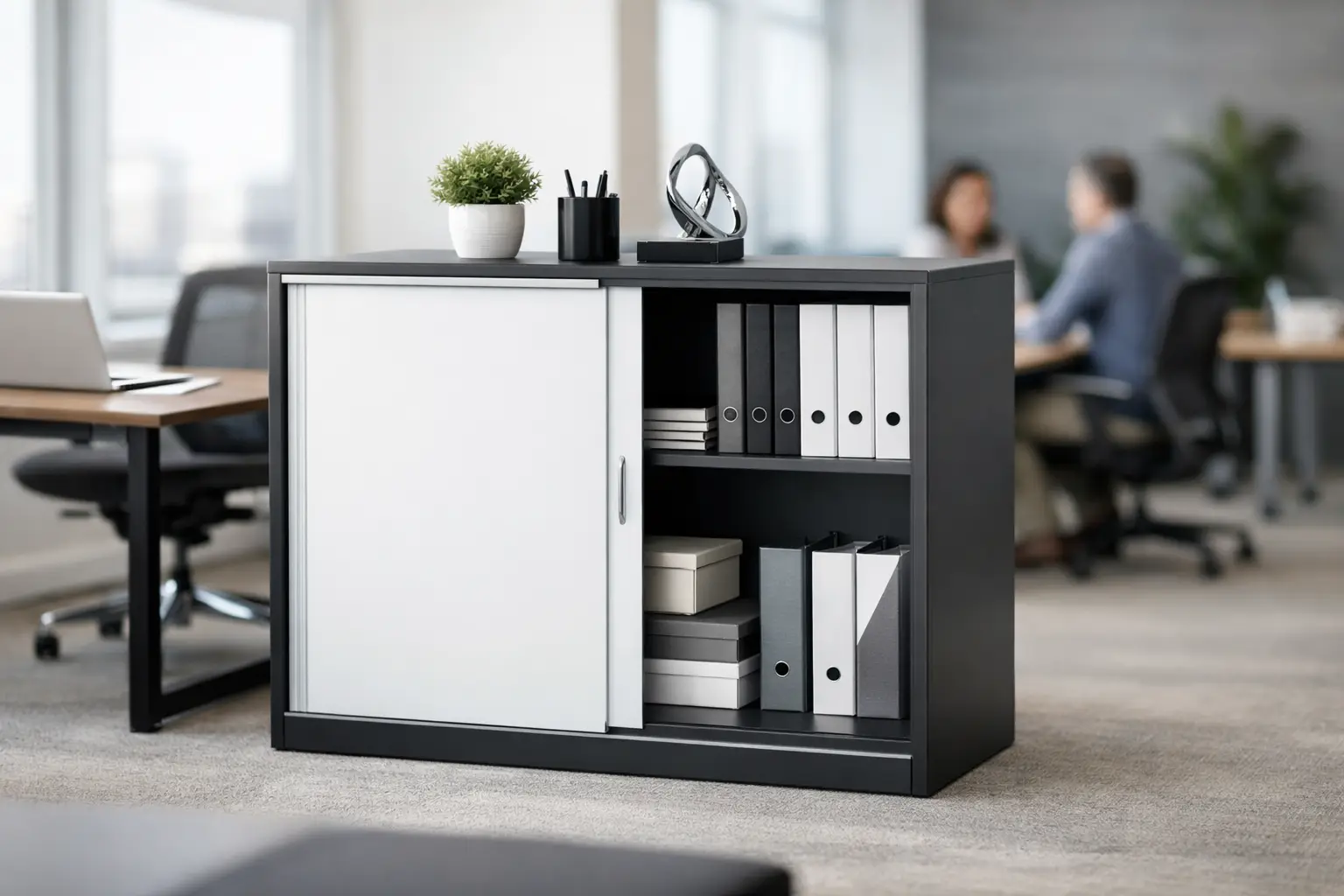
A cabinet door that swings into a narrow aisle can turn a simple filing task into a daily obstruction. In offices, schools, healthcare facilities, and administrative areas, a sliding door office cabinet keeps documents and supplies accessible without claiming extra floor space every time it is opened. For commercial buyers, that practical advantage must be matched by durable steel construction, dependable locking, and dimensions that work with the room plan.
The right cabinet is not simply a storage unit with different doors. It is part of the facility’s workflow. It affects how teams retrieve records, how secure sensitive materials remain, and how efficiently a workplace uses valuable square footage.
Why a sliding door office cabinet saves space
Swing-door cabinets require clear space in front of the unit. This is manageable in a private office, but it becomes a problem in shared work areas, corridors, print rooms, reception back offices, and compact archive rooms. Staff may need to step aside while another person opens the cabinet, and nearby desks or equipment can limit access.
Sliding doors move parallel to the cabinet body. The cabinet can therefore be placed closer to workstations, pathways, or other storage systems without creating a door-swing conflict. This makes the format especially useful where circulation space is limited but documents need to remain within easy reach.
There is a trade-off. A sliding door typically exposes one side of the cabinet at a time, while double swing doors can provide full-width access when both are open. For frequently used large binders or wide equipment, full access may be preferable. For files, stationery, archive boxes, PPE supplies, and general office materials, the space-saving benefit often outweighs that limitation.
Start with the storage task, not the cabinet size
A purchasing decision should begin with what the cabinet will hold and who will use it. General storage cabinets may look similar from the outside, but their internal layout and load requirements can differ significantly.
For document storage, confirm the shelf dimensions, shelf adjustability, and load capacity. Lever-arch files, archive cartons, and boxed records create concentrated weight. Light-duty shelving may sag or deform over time when cabinets are loaded to their full height. A steel cabinet with reinforced shelves is the better long-term choice for active records rooms and departmental filing.
For office supplies, adjustable shelves provide flexibility as stock changes. A facilities team may store printer consumables one month and safety documentation, uniforms, or maintenance materials the next. Adjustable internal configurations reduce the need to replace storage when operational requirements shift.
Where the cabinet will be shared by multiple departments, consider whether separate compartments, individual locks, or clearly labeled shelf zones are needed. A single large cabinet is efficient for centralized storage. It is less suitable when teams need restricted access to different materials.
What commercial buyers should specify
A sliding door office cabinet should be specified as a working asset, not selected only by appearance. Steel thickness, coating quality, lock type, shelf capacity, and door movement all influence performance over years of daily use.
Steel construction and cabinet rigidity
Metal office cabinets are valued for their resistance to impact, wear, and repeated loading. A properly formed steel body maintains alignment under regular use, helping doors run correctly and locks engage consistently. This is particularly important in offices with high staff turnover, shared storage rooms, schools, industrial administration areas, and public-sector facilities.
Ask how the cabinet body, shelves, and doors are constructed. Reinforced folds and rigid panel design matter because they help prevent flexing. A cabinet that twists under load can affect door alignment and shorten the service life of sliding mechanisms.
Powder-coated finishes are also worth assessing. They provide a durable surface that is easier to maintain than painted finishes that can chip with frequent contact. Select a color that supports the facility’s visual standards, but do not treat color as the main specification. Structural quality and functional fit come first.
Doors, tracks, and daily operation
The sliding system should operate smoothly without excessive noise, catching, or lateral movement. In high-use locations, poorly guided doors become a maintenance issue and can lead users to force them open or closed.
Review whether the door design includes stable upper and lower guidance, as well as a track arrangement that resists dust buildup and routine wear. The best configuration depends on the environment. A clean office may prioritize quiet operation and appearance, while an industrial office may require a more tolerant, heavy-duty system that performs reliably despite frequent use.
Door handles should be easy to grip and positioned so users can operate the cabinet without strain. Recessed handles can help maintain a flush front, which is useful where clear walkways are a priority.
Locking and controlled access
Not every office cabinet requires the same level of security. General stationery storage may only need a basic key lock to prevent casual access. Personnel files, contracts, financial documents, controlled forms, and IT accessories may require stronger access management.
For shared workplaces, key management deserves attention. Decide who holds master access, how replacement keys are handled, and whether different cabinets need keyed-alike or keyed-different locks. Keyed-alike systems simplify access for authorized facility personnel. Keyed-different cabinets help separate departmental responsibilities.
A lock protects the doors, but it does not replace good records management. Sensitive files should be classified, access should be assigned clearly, and the cabinet should be positioned away from public-facing areas where possible.
Size the cabinet around the room and the future load
Measure the available wall length, ceiling clearance, and intended access zone before selecting cabinet dimensions. Because sliding doors do not extend into the aisle, the front clearance requirement is reduced. Staff still need enough room to stand comfortably, view labels, and remove folders or cartons.
Cabinet height is a practical decision. Tall models maximize vertical capacity, but items on upper shelves may require a step stool and become less convenient for daily retrieval. Medium-height cabinets can double as work surfaces, printer bases, or document sorting areas. Low cabinets may fit under windows or alongside desks, although they provide less total storage volume.
Do not buy solely for the current inventory. Departments accumulate files, materials, and equipment faster than expected. A cabinet with adjustable shelves and some unused capacity can delay the next storage purchase and simplify future reorganization. That said, oversizing every unit can waste budget and floor area. The right approach is to forecast realistic growth for the next few years, then match capacity to the expected use cycle.
Where sliding-door cabinets work best
A sliding door office cabinet is a strong fit for active administrative environments where floor space and reliable access both matter. In a school office, it can organize student records, supplies, and forms without blocking a shared workspace. In a healthcare administration area, it can hold non-clinical files and controlled office stock in a compact footprint.
In industrial facilities, offices often sit close to production support areas, dispatch desks, or maintenance departments. These spaces benefit from steel storage that tolerates demanding use and keeps documentation, manuals, and operational supplies organized. In commercial fit-out projects, sliding-door cabinets can also create a consistent storage solution across meeting rooms, back offices, reception support areas, and archives.
For distributors and project buyers, standard cabinet dimensions can support faster procurement when requirements are straightforward. Custom metal fabrication becomes valuable when a project needs nonstandard widths, special shelf layouts, specific colors, additional locking arrangements, or cabinets designed to integrate with an existing workspace.
Avoid common specification mistakes
The most frequent mistake is choosing a cabinet based only on external dimensions. A unit may fit the wall but fail to accommodate the actual folder height, box depth, or shelf loading required. Request internal dimensions and shelf load information before confirming an order.
Another mistake is ignoring access patterns. If one person opens the cabinet occasionally, nearly any suitable model may work. If several employees access it throughout the day, door movement, handle design, labeling, and shelf organization become much more significant.
Buyers should also avoid treating a standard office cabinet as a universal storage solution. Chemicals, batteries, charging devices, and certain PPE items can require purpose-built cabinets with ventilation, containment, charging provisions, or dedicated configurations. A sliding-door unit is excellent for general commercial storage, but specialized risks need specialized equipment.
A supplier should support the full project
For a single office upgrade, a standard steel cabinet may be the most efficient route. For a multi-site rollout, a school refurbishment, or a commercial fit-out, supplier capability becomes part of the specification. Consistent production quality, reliable lead times, flexible quantities, and the ability to coordinate multiple storage categories can reduce project complexity.
Loxmet manufactures heavy-duty metal storage for commercial environments, with standard and custom options for buyers who need cabinets that fit operational requirements rather than generic room layouts. The value is not only in the cabinet itself. It is in receiving a storage solution that can be repeated, maintained, and expanded as the facility changes.
Choose the cabinet after reviewing the items it will hold, the traffic around it, and the people responsible for access. A well-specified sliding-door model will stay out of the way, keep work materials organized, and continue performing long after lighter furniture has become a replacement cost.